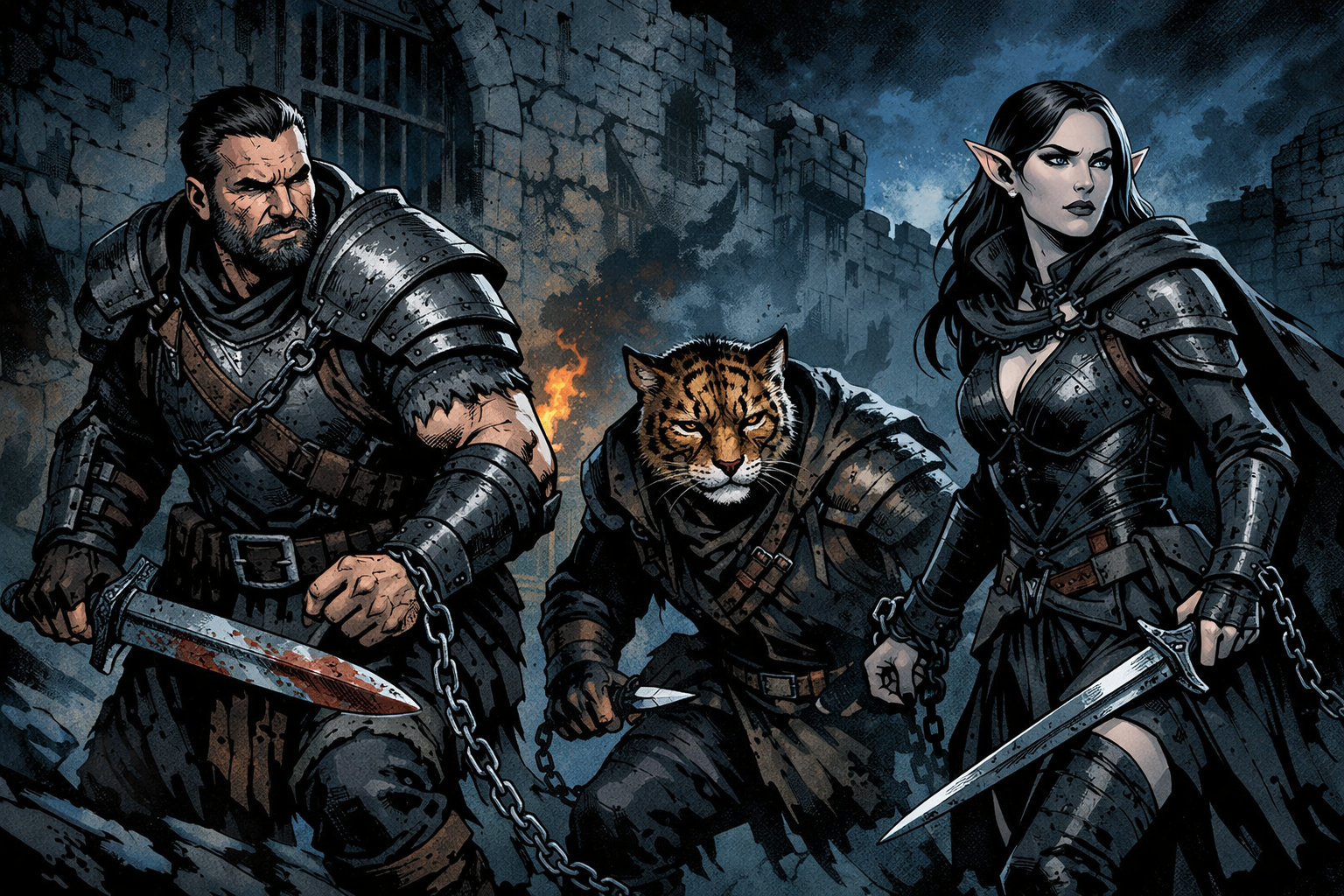
Beat 1: The Shockwave
It begins as a single clean detonation somewhere above, not a prolonged barrage but a precise punctuation mark. The cell block shudders. Dust drifts down in lazy sheets. A distant scream rises, then cuts short like a cord snapped tight. For a heartbeat there is silence again, thin and unnatural, followed by the sound of running boots and shouted orders in a language that turns the air sharp. A lock clicks open on its own, or a hinge finally gives, or a key ring skitters across the stones within reach. The PCs feel it immediately: the fort is not in control anymore, and whatever is taking control does not care who survives. Give them an immediate route to act. Bend bars, slip a pin into a lock, wrench a chain against iron. Then punish hesitation. If they wait, opportunity closes: a guard slams a door, a patrol floods the hall, fire reaches straw, or a collapse blocks the clean path and forces the ugly one.
Beat 2: Keys in the Dark
Warden Brolin appears with a ring of keys and sweat soaking through his bravado. He is not here to save anyone. He is here to survive, preferably with leverage, and he tries to speak like a man still in charge: “You lot stay put. I’m the only reason these doors open, and I’m not dying for…” He stops because blue light dances along the ceiling, and somewhere down the hall someone screams and stops screaming. Brolin’s eyes dart to the shadows; he is the kind of man who would sell the world for another minute. Let the PCs decide what they are in that moment. They can intimidate him, trick him, bribe him, or take the keys. Make it clear that every option has a texture: violence is fast and loud, words are slow and fragile, mercy is an investment that can pay off or come back with teeth. If they spare him, remember it. If he lives, he becomes a future complication with a long memory and a deep need to blame someone.
Beat 3: The Evidence Locker
The evidence door is thick, the lock stubborn, and the corridor outside it is full of smoke and urgent footsteps. Two wounded legionaries are trying to barricade it, faces pale with shock, and with them is Sergeant Dalia Cassia, eyes bright with exhaustion, the look of someone who has already decided to do something questionable because the alternative is worse. “You’re prisoners. I’m not blind. But if you can carry a man and keep your mouth shut, I can pretend I never saw you.” This is where the PCs recover their gear and their agency: improvised weapons, a guard’s cuirass, a pouch of components, a ring that mattered, a journal that explains why they were taken in the first place. Among the shelves is also something that doesn’t belong with common contraband: a wax-sealed packet marked only by a discreet stamp. The sealed dossier. If they take it, they inherit the night’s real weight. If they leave it, they may still escape, but the campaign’s hook slips away into Thalmor hands unless you reintroduce it later through a different betrayal.
Beat 4: Smoke and the Cost of Mercy
Near the infirmary, smoke rolls low, hugging the floor like something alive. Someone cries for help. A soldier is pinned beneath debris, not dead yet, and every second is a bargain between time and conscience. Saving him costs noise and delay, but it can also earn a guide, a key, a witness, or simply the first moment the PCs feel like more than animals in a trap. Leaving him costs something quieter that you can make real later: the soldier’s face on a survivor who recognizes them, a rumor that “they stepped over the dying,” or a private guilt that bends decisions in future scenes. Either choice is valid; what matters is that it feels like a choice, not background scenery.
Beat 5: The Paper Trail
In the command office the PCs can see the shape of the crime. The fort has paperwork for everything (rations, patrol routes, disciplinary reports), and yet the detainee’s name appears only in a letter referencing an “unregistered prisoner,” pressure from above, and instructions that read like someone trying to erase a person by administrative force. Captain Rorik Varo may confront them here, blade drawn, eyes bloodshot, not sure who he hates more: the Thalmor, or his own helplessness. “If you did this, I’ll hang you myself. If you didn’t… then tell me what we’re facing.” Let this scene be an option for talk, theft, or flight. The PCs can talk him down and gain a temporary ally, steal documents and a map, or flee when the ceiling groans and the truth threatens to collapse under stone.
Beat 6: The Courtyard Extraction
The courtyard is where the night becomes visible. Firelight paints everything in harsh color. The Thalmor moves in clean geometry around Ammar al-Rihad, cold light pinning him, his jaw set, not pleading but measuring. Justiciar Larethil stands close enough to end him, far enough to never be touched, and his voice carries like a sentence already written. “Step aside. I don’t want to waste time on people the Empire already threw away.” Ammar turns just enough to meet the PCs’ eyes if he can, and what he offers is not a speech but a decision: “You have ten seconds to decide what you are. Then you are whatever survives.” Here is the core fork. The PCs can intervene, fast and brutal, trying to disrupt the extraction. They can steal the dossier in the confusion and run. They can slip away via the postern with S’rifa, choosing survival over heroics. Whatever they do, make it cost something tangible: blood spilled, a friend left behind, exposure that means wanted posters tomorrow, or a choice that haunts them later.
Beat 7: The Last Door
The final exit should feel like a decision, not a hallway. The ramparts are faster and visible, a sprint under moonlight and arrows. The sewer is slower and safer until it isn’t, a crawl through filth and collapsed stone while the sound of boots fades above. Let them win distance, not victory. Behind them the fortress is a wounded animal, roaring with fire and thunder, and somewhere in that noise is the steady cadence of Thalmor commands, measured, certain, unhurried, as if time belongs to them.
End the scenario the moment the PCs are out. Not safe. Just out. Cold air, wind, the fortress behind them, and dawn beginning to bleed into the sky. If they carry the sealed dossier, let the wax feel warm from body heat and wrong in the hand, like a living thing. If they don’t, let them hear Larethil’s voice in memory and understand they escaped something that was never meant to leave witnesses.
“Run. Don’t be brave. Be alive.”
S’rifa