The PCs do not leave the fortress like heroes. They leave like smoke, like something the world tried to choke and failed to finish. Behind them, stone still shudders with distant impacts, the night still flashes with hard blue light, and the screams that were cut short inside the walls do not come back. Outside, the air is colder than it should be, wind scraping across rock and scrub as if the land itself wants to erase their footprints. For a few breaths there is the illusion of freedom, the kind you only feel when you stop hearing keys and chains. Then the truth arrives in the only language it ever uses: sound. Boots on stone. A horn that starts and falters. A shouted command carried on the wind. The fort is not done with them.
← Back to Act I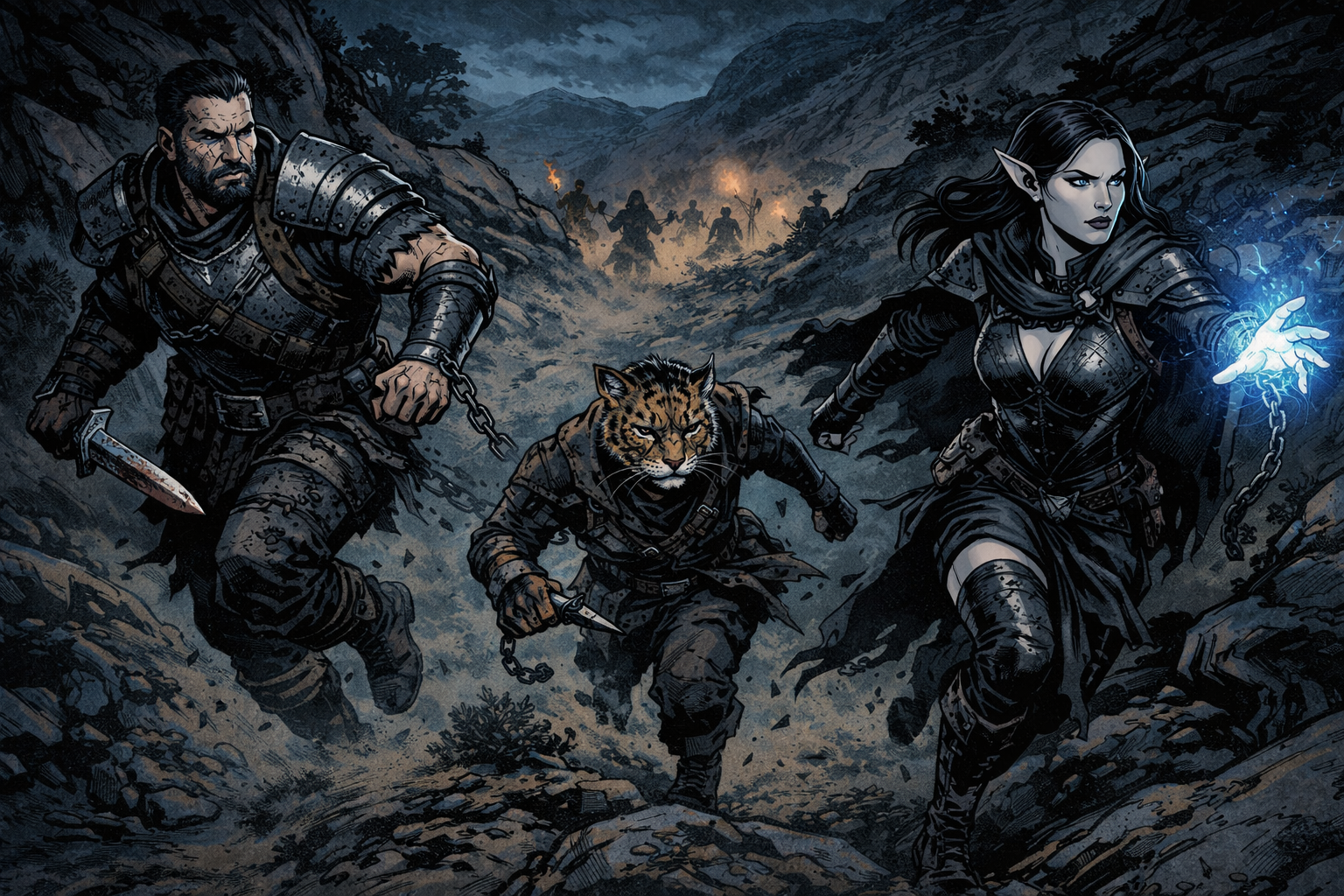
The Hills That Hunt
Opening
Campaign Note
Read aloud (optional)
“You run until your chest hurts, then you run again because the hurt is simpler than the thought of turning back. The night is wide, but it is not empty. Somewhere behind you, someone is counting footsteps like debts.”
What they carry
They emerge into the border hills of Hammerfell with whatever they managed to steal from the belly of the place. A guard’s cuirass that does not fit right, straps too tight, buckles half broken. A dented helm tucked under an arm. A blade that used to belong to someone whose name they will never learn. A pouch of components. A bow with a frayed string. Improvised weapons, borrowed identities, enough to survive, not enough to feel safe. The world opens wide around them, and it is immediately clear that wide does not mean freedom. It means exposure. They are free, yes, but they are pursued. Maybe it is the remnants of the Imperial garrison, panicked and furious, desperate to find someone to blame before sunrise turns rumors into reports. Maybe it is the Thalmor, methodical even in retreat, their scouts already reading the ground like a page, their mages tasting the air for traces of fleeing minds. Or maybe it is both, two different kinds of danger pressing in from behind, one loud and human, one quiet and precise. Either way, the hills become a corridor with no walls, and the party has to learn quickly that running is not a single action. It is a sequence of decisions you make while your lungs burn.
S’rifa : “Do not outrun them. Outthink them. Let the land do the killing for you.”
The Border Hills
Hammerfell’s border country is beautiful in the way a blade is beautiful. Rocky slopes that punish weak ankles, scrub that tears at cloth, narrow cuts in the land where you can vanish for a moment if you choose the right line. Dry riverbeds that look like safety until you remember they carry sound. Ridges that promise distance and deliver silhouettes. The sky is huge, the stars cold, the moon indifferent. Even the wind feels like it is taking sides.
There are places that feel like shelter and become traps if you stay too long. A shallow cave that smells of old animal and damp stone, safe for five minutes, deadly if you make it home. A half collapsed watchtower on a rise, offering a view and the bones of a trap, also offering a silhouette for anyone looking up. A stand of thorn scrub thick enough to hide you if you can endure the cuts without making a sound. A narrow pass between two slabs of rock where one person can hold off three for a moment, and then everyone has to decide what that moment is worth.
How to Run It
Do not run this as a straight chase with a single finish line. Run it as a tightening rhythm: sprint, hide, listen, move, gamble, breathe, then sprint again. The pursuers do not need to be visible constantly. They need to be inevitable. A distant torch glow that should not be there. The snap of a branch where nobody should be standing. A patrol call answered too quickly. The sense that someone is close enough to be quiet. Use skill checks as pressure valves rather than puzzles. When a player succeeds, let it move them forward quickly and change the shape of the pursuit in their favor. When they fail, do not stop the story. Add complications: exhaustion, a wrong turn, noise, a dropped item, a minor injury, a patrol that was not supposed to be there. Make the land harsher, make the pursuers closer, make the dawn more dangerous than the dark. Keep the outcome focused on separation, not triumph. They do not need to defeat the hunt tonight. They only need to survive it.
Play Sequence (Beats)
Beat 1: The Open Ground
The first stretch is the cruelest because it is simple. The fort is behind them, the hills ahead, and the space between is exposed. Breath clouds in the cold. Metal buckles click if they do not bind them. If anyone looks back, they can see torchlight beginning to organize, not scattered panic anymore, but lines. If you want a hard opening choice, make them pick a route quickly: the ridge for speed and visibility, the gully for cover and slower footing, the dry wash for a clean line that carries sound.
Let them feel the cost of gear. Heavy armor buys protection and steals silence. A stolen helm saves a life and makes a head turn in moonlight. Make them decide what they keep.
Beat 2: First Contact
The pursuers become real. Not a roar, not a swarm, a small shape on a ridge behind them, then two. A call. A reply. The hunt begins to take structure. If it is the Imperials, they are loud, angry, human, they shout names they do not know and threats they cannot afford to keep. If it is the Thalmor, it is quieter, colder, and more frightening for that. Their voices do not rise. Their signals are minimal. Their confidence is the sound.
Offer the players a quick win that still costs something. They can sprint and widen the gap, but burn stamina. They can hide and risk being swept, but save breath. They can use Illusion to throw a sound to the wrong hillside, but leave a taste in the air that sharp minds can follow.
Beat 3: The Land as a Weapon
This is where the border hills stop being scenery and become a tool. Let Survival matter. Stony ground that does not hold prints. Windward slopes that carry scent away. A thin goat trail that breaks line of sight if they can trust their feet. A place where they can smear dust over bright metal, wrap cloth around buckles, and become less visible.
If they do it well, reward them with something palpable: the patrol passes within earshot and does not notice. A torch pauses, then moves on. The party gets one full minute of silence, and it feels like a miracle.
Beat 4: The Sweep
Make the pursuers change tactics. They stop chasing straight and start sweeping. They split. One group takes the ridge, one group takes the low ground, and suddenly hiding becomes harder because there is no single direction to fear. This is where Stealth and Perception are king. The party needs to read the land and read the hunters, notice the torch that is too steady, the quiet shape that does not belong, the absence of sound that means someone is close.
If you want tension without combat, let them hear a conversation they were not meant to hear. A name. A directive. A detail that proves the Thalmor knows more than it should.
Justiciar Larethil : “If they carry it, they do not reach morning.”
Beat 5: The Hard Choice
Put a human problem in the middle of the chase. Someone stumbles. Someone bleeds. Someone is too exhausted to climb. Or they find a terrified deserter from the fort, hiding under thorn scrub, clutching a key and shaking. Helping costs time. Leaving costs something quieter. Either way, the hunt closes in.
If the party chooses speed, let them gain distance but lose something: a dropped pack, a discarded piece of armor, the sound of a friend’s breath turning ragged. If they choose mercy, let it matter: the deserter becomes a guide to a hidden hollow, or the wounded soldier later becomes the witness who tells the wrong people they are alive.
Beat 6: The Break in the Pattern
Give them one chance to break the hunt cleanly. A narrow pass where one person can delay the pursuers for a heartbeat. A fallen boulder they can shove to block a path. A brief storm gust that wipes tracks. A simple Illusion that makes their silhouettes appear on the wrong ridge for a single crucial moment.
Make it feel like a gamble, not a trick. If it works, the pursuit does not end, it shifts. The pursuers lose certainty. They slow to search. They argue. They reorganize. That is the prize: confusion, bought with risk.
Beat 7: The Dawn Hollow
End the pursuit the moment they are out, not safe, just out. Dawn thins the darkness. The hills take on bruised color. With light comes the next danger: witnesses, roads, villages, posters, names. The party finds a hollow between rocks where the wind covers sound, or a fold of land where they cannot be seen from above. For the first time since the fort, they can breathe without hearing boots behind them.
If they carry the sealed dossier, let the wax feel warm from body heat and wrong in the hand, like a living thing. If they do not, let them hear the calm cadence of Thalmor voices in memory and understand they escaped something that was never meant to leave witnesses.
S’rifa : “Do not celebrate. Do not speak your names yet. Morning is when the world starts asking questions.”