The dawn does not feel like safety. It feels like visibility. The sky pales, the shadows retreat, and suddenly there is nowhere to hide except inside other people’s lives. The party reaches the first sign of civilization the way shipwreck survivors reach shore: half expecting the land to reject them. A low border settlement, part village, part caravan stop, built from stone and weathered wood, crouched beside a road that sees more travelers than it trusts. Smoke rises from a few chimneys. Pack animals stamp in a corral. A bell chimes once in the wind and then falls quiet, as if remembering it has no right to announce anything.
← Back to Act I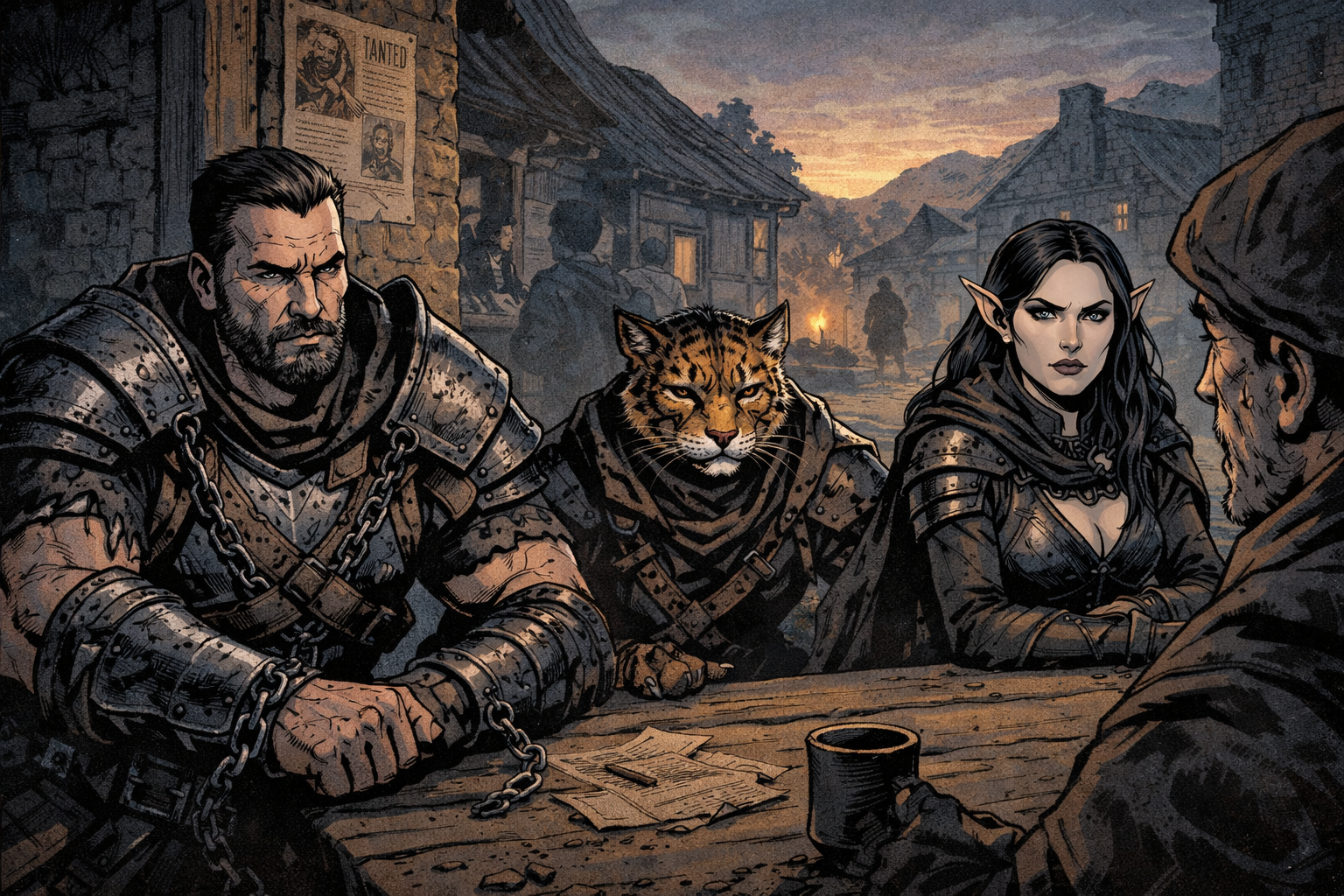
The Thin Refuge
Opening
Campaign Note
Read aloud (optional)
“The first thing you notice is the smell: bread, animal sweat, ash, and old dust. Not the clean scent of safety. The human scent of places that survive by minding their own business. People look at you the way they look at bad weather: not curious, not kind, just measuring how close it might get.”
The Border Stop
There is a single main street, more track than road, lined with a few low buildings that have learned not to stand tall. A tavern with a sign sun-bleached into anonymity. A smithy whose anvil ring is muted this early. A shrine niche set into a wall where someone has left a handful of dried flowers and a coin rubbed smooth. A notice board fixed to a post like a public throat, covered in old warnings and fresh paper. Beyond it, a caravan yard where tents are still half-collapsed from the night, and merchants wake with hands already counting losses and gains. The village has a face for outsiders, and another face for trouble. You can feel the second one behind shutters.
What This Scene Does
This is the first time the PCs can breathe without running. It is also the first time they have to talk. The pursuit is behind them, but the consequences are arriving ahead of them, carried by rumor, by authority, by paper. This scene introduces three things: suspicion, leverage, and the hook that pulls the campaign forward. The party can choose to become a story people tell, or a shadow people forget, but either way they need something now: shelter, water, a plan, and information. Use skill checks as social pressure rather than gates. A success gets help. A failure gets help with strings, or help that costs pride, coin, or time.
Play Sequence (Beats)
Beat 1: Entering Without a Name
They step into the settlement looking like what they are: people who ran through the night. Dust in hair, blood on cloth, armor that doesn’t match, eyes that keep checking corners. A stablehand pauses mid-task and watches too long. A merchant pulls their purse closer without realizing they’re doing it. A child stares with the blunt honesty of someone who hasn’t learned fear yet, until a parent drags them away.
Give the party a moment to decide how they present themselves. Do they hide the armor under cloaks, smear dirt to dull bright metal, pretend to be caravan guards who got separated, or walk in as themselves and dare the world to ask? None of these choices are “wrong.” They just create different problems.
Beat 2: The First Door
They need a place to sit. A place to drink. A place to not collapse in the street. The obvious answer is the tavern, and the obvious answers in Elder Scrolls are never safe. Inside, the air is warm with stale smoke and early stew. Mara-Lys does not smile. Not because she’s cruel, but because smiles are promises and promises cost money. She asks the question that matters without asking it outright: what kind of trouble follows you?
This is your first social test. If the party speaks well, offers coin, tells a believable story, or simply looks like they can pay, they get a corner, water, and silence. If they stumble, contradict each other, or look too desperate, Mara-Lys still helps, but the help comes with eyes on them. A runner sent to “check something.” A door that stays half open. A stranger who pretends not to listen.
Campaign Note
Optional lines you can use
Mara-Lys: “You look like you outran something. Out here, that means it’s either still chasing you, or it wants you found.”
Traveler at the bar (Ra’zzir): “Hammerfell hills don’t give people gifts. They take. So what did you steal from the night?”
Beat 3: Paper on a Post
Somewhere outside, on the notice board, a fresh sheet of paper flutters in the morning wind. It is not official enough to be Imperial. It is too clean to be local. The ink is still dark. The sketch is crude but pointed. A description that could fit one of them too well, or fit all of them if read with suspicion. Wanted. For questioning. For theft. For murder. For “suspected collaboration.” The charge matters less than the fact of the paper. This is where Perception pays. Let a sharp-eyed PC spot it before someone else does. Let them see the small detail that makes it worse: a wax mark in the corner, subtle, not the Legion’s stamp. A private seal. A sign that someone is hunting them with resources.
If they tear it down, they create witnesses. If they leave it, they create risk. If they replace it, they create a new kind of danger. Let them choose.
Beat 4: The Village Tests Them
The settlement is not evil. It is cautious. It has survived by learning when to shut doors and when to open them for coin. If the party asks for help, the village will ask for something back, even if it’s small.
Offer them one or two quick social situations that teach the tone of the campaign. A caravan master will trade information for a favor, like guarding a wagon for an hour, or retrieving a runaway pack animal from a nearby ravine. A priest at the shrine will offer a blessing and a hiding place if the party tells the truth, or if they bring water from the well to the infirm. A suspicious guard will “forget” he saw them if they can persuade him they’re not Thalmor agents, and that persuasion can be gentle, clever, or sharp.
This is where Speech matters, but in different flavors. Sweet talk gets you warmth. Firm confidence gets you space. Threats get you results and enemies. And silence can work too, if the party looks competent enough that people would rather not know.
Watchman Keld Orrin : “I don’t care what you did in the dark. I care what follows you into my morning.”
Beat 5: The Stranger in the Corner
Introduce a person who is watching them with intent. Not necessarily hostile. Just focused.
S’rifa may be here, already seated, as if she arrived before dawn without ever being seen. Or it might be someone else: a caravan scout, a retired legionary, a local smuggler who knows what “off the books” looks like. The important thing is that the party realizes they are being observed, and that this observer knows something.
If you want immediate tension, have the observer say one sentence that proves it. Something they should not know. A detail from the fort. A name the party never spoke aloud.
Campaign Note
Observer (choose one)
S’rifa: “Fortress fires don’t start that clean. That was a retrieval.”
Riven Sloane: “If you walked out of that place, you’re either lucky, or you’re holding something someone will burn a town to get back.”
Beat 6: Ammar al-Rihad’s Thank You
If the party crossed paths with Ammar al-Rihad and he survived, this is the moment that shifts the campaign from flight to purpose. He is not sentimental. He is exhausted. He has the posture of a man who has been erased on paper and forced to live anyway.
He does not give them a speech. He gives them a truth.
If the Thalmor struck that hard for a single detainee and a sealed dossier, it means what’s inside is worth more than lives. It means someone is building something, preparing an expedition, moving Dwemer artifacts like contraband. It means this was never meant to be public, and that secrecy is the real weapon.
Ammar thanks them the way people thank you when they know the debt might get you killed: quietly, quickly, with no expectation you’ll accept it. Then he slips them a name.
A contact in the nearest city. Wayrest, if you want politics and archives. Sentinel, if you want ports, caravans, and Thalmor shadows in bright light. The name is simple, ordinary, easy to forget if you’re not careful. That’s why it works.
Ammar al-Rihad : “Don’t say it twice. Don’t write it down where someone can find it.”
Ammar al-Rihad : “If you want to live past next week, you need someone who knows how to make people disappear on purpose.”
Ammar al-Rihad : “Find this person. Show them the seal. If they deny you, leave. If they don’t, listen.”
Ammar al-Rihad : “If you want to live past next week, you need someone who knows how to make people disappear on purpose.”
Ammar al-Rihad : “Find this person. Show them the seal. If they deny you, leave. If they don’t, listen.”
Beat 7: A Door Opens, Another Closes
End the scene with a decision that feels like the first real step of a campaign. The party can stay one more hour and recover, risking that the wrong eyes arrive with daylight. Or they can leave immediately, exhausted but unseen. Or they can accept a local job to earn coin and cover, risking delay. Or they can move straight toward the city contact, carrying the dossier like a heartbeat they can’t stop hearing.
Give them one final sensory beat to ground it. The warmth of a cup in shaking hands. The rasp of dried blood under a bandage. The sound of a hammer striking an anvil and the flinch that follows because it sounds too much like doors slamming. The notice board creaking in the wind. The sealed wax, softened by body heat, stubbornly refusing to crack unless they choose to break it.
This is not safety. It is refuge. A thin difference, and tonight they will learn how much a thin difference matters.
S’rifa : “You wanted a new life. Congratulations. Now you have to keep it.”