Free but destitute, the adventurers set out on the road to learn more about what happened and why. Act II mixes exploration of Tamriel, investigation, and travel, slowly tightening tension toward the main conflict. At this stage, the party is still working with modest competence: skilled enough to survive regional trouble, not yet strong enough to stare down legendary forces and live. Their victories come from choices, not raw power. Their mistakes leave marks.
← Back to Act II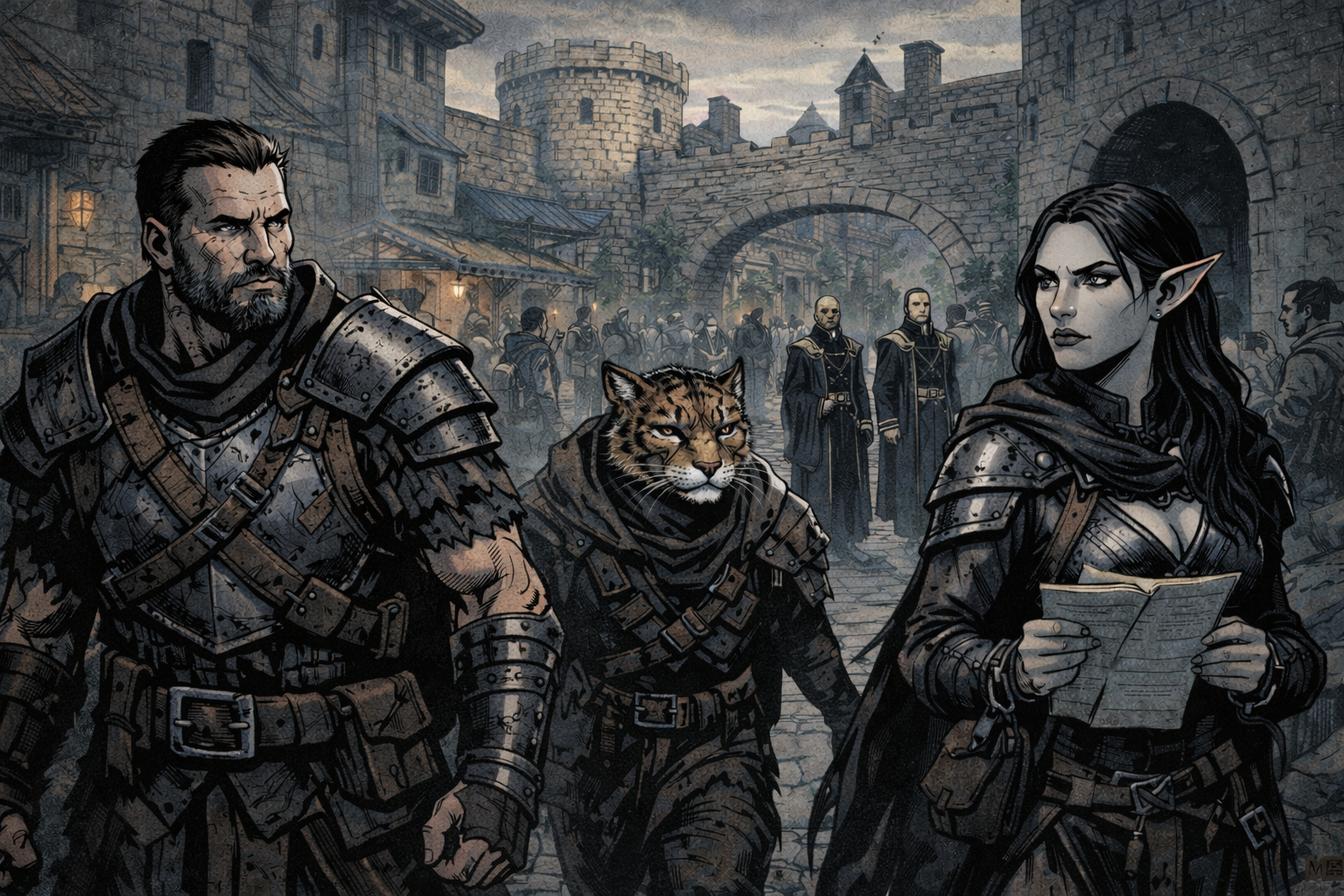
The City of Paper & Quiet Knives
Synopsis
Campaign Note
Read aloud (optional)
“You thought escaping the fortress would make the world quiet again. Instead it gets louder, just in different ways. On the road, every traveler is a rumor with boots. Every inn is a notice board waiting for fresh paper. Every city gate is a mouth that wants your name.”
A Journey to a Great City
They head for the nearest important city, because big places hide small people and because information pools where power gathers. Choose the city that fits your tone. Wayrest if you want velvet politics, polished stone, and secrets hidden in ink. Sentinel if you want sunlit walls, caravans, ports, and deals made in shade while the street looks bright. Either way, this is the party’s first test outside the wilderness: not whether they can survive, but whether they can move through society without being pinned to the page.
They arrive with mismatched gear and the wrong kind of silence. A guard’s cuirass that doesn’t fit, a blade with someone else’s initials scratched near the hilt, dust ground into their hair, eyes that keep checking corners. Cities notice that kind of thing, not with alarm at first, but with attention. Attention is how problems begin. They come for two reasons that are hard to separate. Coin, because they can’t eat stories. And a contact, because the sealed dossier (or Ammar al-Rihad’s name) is worthless unless someone in the city knows what it means. The contact from Act I is a thread. The party needs to pull it without snapping it, because threads in cities are often attached to knives.
Campaign Note
Campaign note (city in 10 minutes)
If you want the city to feel immediately alive, show three things quickly: the market where they can sell loot, the notice board where paper becomes a weapon, and one quiet sign of Thalmor presence that doesn’t match the local culture.
The City
The gate district smells like sweat, damp wool, and bribes that pretend to be fees. The market smells like spice, metal, and impatience, with merchants who can appraise a stolen sword the way a priest can appraise guilt. Inns feel warm until you remember warmth attracts people who want something. Scholar streets feel clean until you notice how many doors are locked from the inside. And everywhere there are eyes: guards, beggars, scribes, children, fences, priests, and bored men who look too still for boredom.
In Wayrest, power is careful and elegant. The city has the posture of a court. Words matter. Names matter. Records matter. In Sentinel, power is practical and immediate. The city has the posture of a port. Routes matter. Coin matters. Who you know matters. Both cities are dangerous, but in different flavors. Wayrest kills you politely. Sentinel kills you quickly and lets the sun dry the blood.
How to Run It
Treat this scenario as investigation under pressure, not a sightseeing tour. The party should feel the city as a living machine: a place that can hide them and also grind them down if they move wrong. Let conversations have stakes. Let buying a room have consequences. Let selling loot create witnesses. Use skill checks to shape outcomes, not to block progress. Success should buy safety, access, and time. Failure should add heat, suspicion, and cost, but still move the story forward.
Most importantly, present the Thalmor as what they are: competent. They do not swagger. They do not start street fights. They gather, pressure, and retrieve. Their violence is clean, and that is what makes it frightening.
Play Sequence (Beats)
Beat 1: At the Gates
The first test is a pen and a bored face. A guard asks where they came from. A clerk asks for names, destinations, and reasons that can be written down. The party has to choose a mask. Pilgrims. Caravan guards. Mercenaries looking for work. Traders who lost their goods. The mask doesn’t need to be perfect. It needs to be consistent. If they argue among themselves here, the city remembers them. If they cooperate, the city shrugs and moves on, which is its own kind of mercy.
Gate clerk Oren Hale : “Name. Occupation. Purpose. If you hesitate, I assume you’re deciding which lie costs less.”
Beat 2: The Market and the Price of Coin
They need money and cover. The market offers both and threatens both. A fence will buy stolen gear without questions. Someone like Lysa Venn will pay fast, but will remember faces and tell the right people if the right coin appears. A respectable trader will pay less, ask more, and involve the party in paperwork that creates a trail. A healer will bandage them for coin or for a story. Someone like Healer Maren Dusk will treat them and remember the details, and stories travel.
Give them a chance to stabilize: a few coins, a cheap room, food, and supplies. Then show the shadow of that stabilization: someone watched the transaction. Someone noticed mismatched armor. Someone clocked that the party is new, tired, and trying not to look hunted.
Campaign Note
Campaign note (first Thalmor sign)
This is a good moment to drop a subtle sign: a merchant mentioning “foreign inspectors” asking about Dwemer scrap, a scribe like Pellan Wyr complaining that certain archives were “reserved,” or a scholar’s apprentice like Sera Linne looking shaken after a polite visit.
Beat 3: The Contact Thread
The party follows Ammar’s name or the sealed dossier’s hint to the contact. Don’t make it a single door. Make it a small chain of social steps so the city feels layered. A message left with a tavern runner. A bookshop where the owner sells “rare texts” and rarer information, someone like Nahla bint-Sahir. A caravan factor who only speaks in back rooms. A clerk who knows which files disappear and which people disappear.
Pip : “If you want a name to reach the right ear, you don’t shout it. You pay someone to walk it.”
When they finally reach the contact, the contact tests them. Not with violence, with calibration. Are these people loud trouble, or the kind of trouble that survives?
Choose your contact based on the city:
- Wayrest: Archivist Celinne Fairmont: velvet politics, ink, archives, and doors that lock from the inside.
- Sentinel: Caravan Factor Salim Jarin: ports, routes, back rooms, and names traded for coin.
“You don’t come to me because you’re brave. You come to me because you’re out of options. That makes you useful, if you can keep your mouth shut.”
the contact
the contact
Beat 4: The Conspiracy in Plain Sight
Once the contact opens the right angle, the party begins to see the pattern. Thalmor agents in a city where they should not be comfortable. Not marching, not announcing themselves, but occupying key points: archives, scholars, translators, Dwemer traders, anyone whose mind can be squeezed for information.
In Wayrest, this looks like sealed letters, polite pressure, restricted collections, scholars who cancel meetings and don’t explain why. In Sentinel, it looks like agents near the docks, asking about shipments, buying routes, watching local experts in Dwemer ruins, offering coin for “harmless curiosities” and then coming back when refused.
The party should feel the shift from rumor to mechanism. The fortress raid was one move. This is the rest of the hand.
Beat 5: The Secret Meeting
The contact gives them a location, or the party stumbles into it by following the wrong person and being clever enough to survive it. A rented room above an inn. A back chamber in a scholar’s house. A counting-house office that should hold ledgers and instead holds whispers.
This is where the party spies. They are not strong enough to kick down the door and live, and the Thalmor doesn’t leave obvious evidence where obvious people can find it. This scene should feel like holding your breath in a room full of knives.
Give them a way in that feels like a choice, not a trick: a stairwell that creaks unless someone pads it with cloth; a servant corridor that smells of soap and old ash; a balcony across the street where you can see silhouettes through thin curtains; a vent that carries voices like smoke. They don’t need to hear everything. They need to hear enough.
The party’s goal is simple: steal fragments. A phrase. A name. A direction. A confirmation that the fortress raid wasn’t an accident. It was a move in a larger hand.
Campaign Note
Optional overheard lines
“The site is ready. Keep the locals quiet.”
“The artifacts are moving. The schedule is tight.”
“Alinor wants this finished before anyone notices what they’re seeing.”
“We need scholars, not soldiers. Scholars can be bought.”
“Let Inquisitor Syllandil handle the archives. He’s… persuasive.”
Make the risk tangible. A floorboard sighs. A candle goes out at the wrong time. A door latch clicks. A pause in conversation that lasts half a heartbeat too long. The Thalmor does not need to shout to make a room feel smaller.
Beat 6: Heat
Eavesdropping has a price. At some point, something shifts. A pause in conversation. A chair scraping. A door opening somewhere that should not open. The party may escape cleanly and only realize later they were followed for three streets. Or they may be spotted and forced into a short flight through crowds and alleys, burning stamina and spending coin.
Don’t treat “getting spotted” as failure. Treat it as escalation. The PCs can still leave with the fragment they came for. Now it just comes with consequences.
Failure here should not end the scenario. It should tighten it. A description passed to guards. A room no longer safe. A local informant suddenly interested in them. The party still gets the information, but now they also get a clock ticking.
Agent Vaelor : “If they have it, they can be traced. If they can be traced, they can be retrieved.”
Use one of the following outcomes depending on how hard you want the city to bite:
Outcome A: They slip away (clean)
They get out unnoticed. Later, they realize the city still reacted: the contact changes meeting places, a room is suddenly “unavailable,” and Pip stops smiling when the PCs say their names. The prize here is time, and time can still be spent badly.
Outcome B: They are made (seen), but not caught
A glimpse. A shadow that doesn’t belong. A voice that says, politely, “There.” The PCs run. The city becomes a maze of witnesses: a vendor who saw their faces, a guard who saw their boots, a child who repeats the shape of them without understanding. When they reach safety, the safety is thinner. The contact warns them: the next room they rent will be watched, not because the city hates them, but because the city loves coin.
Outcome C: They are caught (captured)
This should be fast, controlled, and terrifyingly polite. Not a street brawl. Hands on wrists. A door closed. A quiet room. If the Thalmor is involved, the face is Inquisitor Syllandil or Agent Vaelor. If locals are involved, it’s a watchman and a clerk and a ledger, and the Thalmor arrives after.
Inquisitor Syllandil : “You misunderstand. This isn’t an accusation. It’s a correction.”
Let the PCs keep agency by choosing what they pay: coin, pride, lies, or something physical. Options that keep the story moving:
- Bribed release: Oren Hale “fixes” a record for a fee; the PCs leave with a trail they didn’t have before.
- Interrogation & warning: the Thalmor lets them go to follow them. A moving target leads to a nest.
- Trade: they surrender a piece of evidence (a signet, a copied note, a name) to keep the dossier hidden.
- Rescue: the contact pulls a string (a door opens, a guard looks away), but the contact’s price increases and trust decreases.
No matter which option you choose, make sure the PCs still leave with at least one useful fragment (the words “construction site” and “expedition,” a name like Syllandil, or a route tied to Alinor). They don’t get punished with silence. They get punished with attention.
Beat 7: Transition to Side Quests
The contact meets them again, or sends word. The tone changes. The party is not just asking questions now. They are a problem. But problems can be useful.
The contact makes it clear: if the party wants deeper access to scholars, routes, and real information, they need coin and cover, fast. They need to become the kind of people the city trusts with unofficial work. That is how they earn introductions and reduce the heat. That is also how the Elder Scrolls world breathes: you solve local problems and the larger story opens because the world decides you are worth telling secrets to.
First Side Quests (hooks, ready to plug in)
You only need one or two. Pick what suits your group and your pacing.
Hook 1: The Night Harvest
A small hamlet outside the city is being hit at night. Crops trampled, tools stolen, a family found dead in their beds with bruises that don’t make sense. The locals whisper draugr. The city calls it bandits and refuses to waste soldiers. The pay is small, but the gratitude is real, and so is the chance to earn a local ally.
Hook 2: The Tavern That Won’t Forget
The innkeeper has a quiet problem. Coin pouches vanish without belts loosening. A regular swears he saw a man who wasn’t in the room. A locked back door opens itself once each night and is always found shut at dawn. The city guard will turn it into arrests. The innkeeper wants it solved quietly, and quiet work pays in silence as much as coin.
Hook 3: The Caravan Through the Pass
A Khajiit caravan needs guards through a dangerous pass. The pay is decent, and the caravan master offers more than coin: routes, discretion, and the kind of information that only people on roads and docks ever really have. If you want the world to feel lived-in, this is where familiar trader rhythms and road politics show up without turning into a lore lecture.
Ra’zzir : “Coin is coin. But discretion? Discretion is what keeps a caravan breathing.”
Campaign Note
Campaign note (tie one detail back)
Tie at least one small detail back to the conspiracy: a bandit with a hidden Thalmor signet, a stolen letter mentioning “the site,” a Dwemer component wrapped like contraband, a scholar’s name spoken with fear, or a phrase the party overheard echoed somewhere it should not be.
Ending
End the scenario when the party accepts one of the side paths. Not because the main plot pauses, but because the world demands payment before it offers deeper truth. They have learned enough to know there is a conspiracy: Thalmor agents are searching archives and watching scholars, chasing something tied to a construction site or expedition on the Alinor side, involving Dwemer artifacts and unknown magical powers. Now they need resources, allies, and cover to keep pulling the thread without being cut.
“You want answers. Fine. But answers don’t feed you, and they don’t hide you. Earn your footing in this city, and I’ll put you in the room where the real names get spoken.”
the contact
the contact