The party leaves the ruin with weight in their packs and weight in their minds. The Dwemer tablet, the aetherium fragment, the journal, the plates of plans, whatever they managed to carry out of the Hollow Brass, all of it is more than loot. It is proof. It is a key. It is the kind of evidence that makes powerful people stop being patient. This is the first hard promise of Act II. The party is not chasing the plot anymore. The plot is chasing them. The confrontation that follows can become a fight, a bargain with knives behind the smiles, or a desperate escape. The party gets to choose. The ambush does not.
← Back to Act II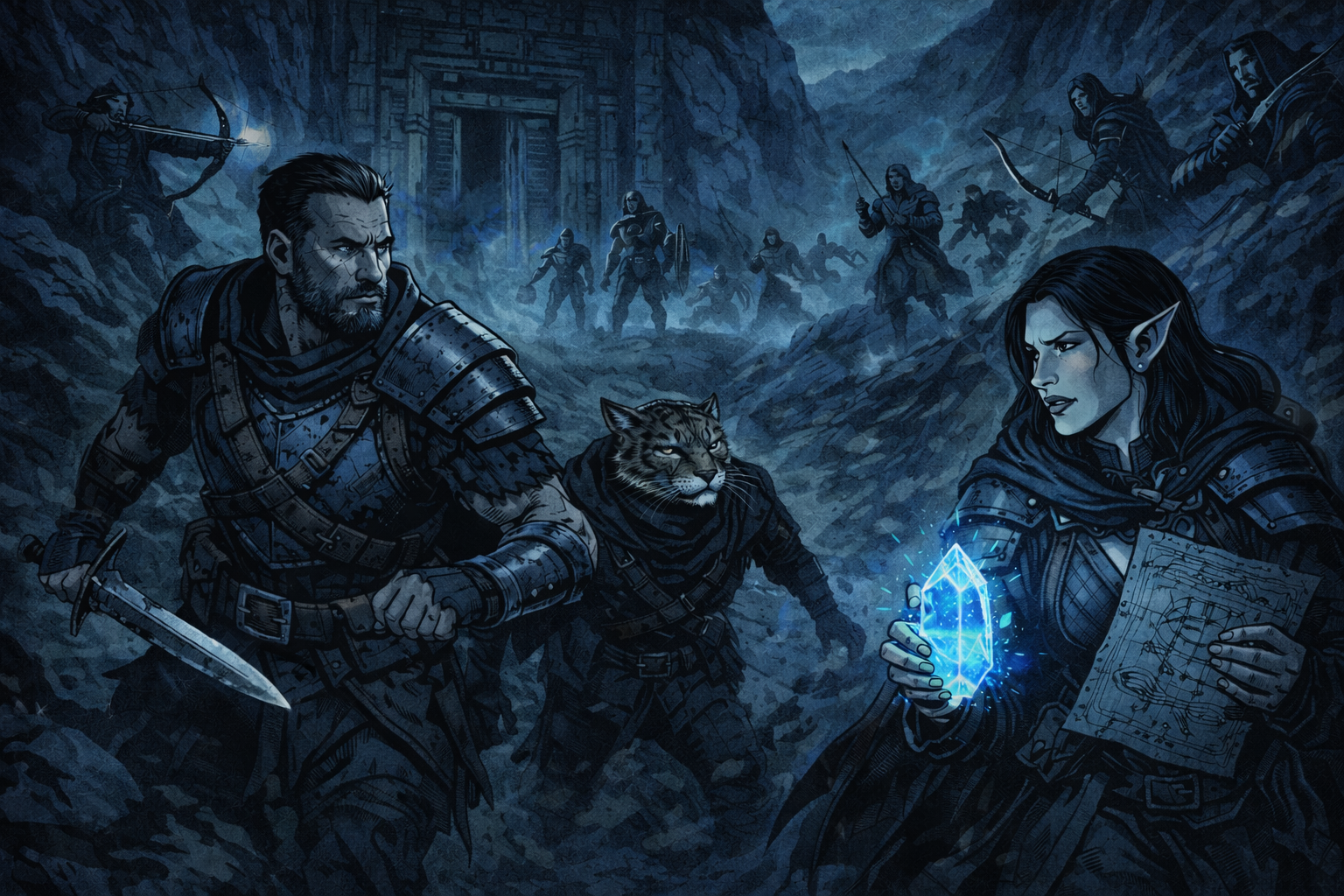
A Courtesy of Steel
Synopsis
Campaign Note
Read aloud (optional)
“You come out of the mountain different than you went in. Not stronger, not yet, but heavier. Knowledge does that. It turns you into a target without asking your permission.”
The setup
Start planting danger before the party ever reaches daylight. Not loud hints, the kind that reward attention. A boot print in dust that doesn’t match their tread. A cut rope that looks recent. A smear of blood on a brass edge that none of them left. An oil rag that smells wrong for a mountain ruin. A small brass token wedged under a stone, etched with a sigil that feels familiar if they handled sealed papers in the city. If the party notices, let them feel clever. It does not remove the ambush. It changes the tone. Surprise becomes tension, and tension feels fair.
The ambush site
Outside the ruin, the mountain air is thin and cold. The sky is too big. The exit path funnels through a choke point that nature already designed for a kill. A broken stone arch that forces you single file. A narrow ledge where the cliff steals your footing. A shallow ravine lined with scrub that offers cover to anyone above. The path ahead looks empty. That is the point. The silence you feel is not peace. It is people holding their breath.
The antagonists
These are not Justiciars in public authority. These are hired hands, plausibly deniable, paid to retrieve and forget. Their leader is Captain Cassian Vel. Practical. Intelligent. Careful. He does not want a fight unless he is sure he wins.
He brings a small team. Enough to control a choke point, not enough to look like an army. A bow on high ground. A shield to pin the path. A minor battlemage or illusionist to blur sight and split attention. Use Linneve if you want the magic to feel precise, and Tomas Rell if you want the archer to feel patient rather than loud. If you want a Thalmor scent without a Thalmor presence, give Cassian a sealed instruction letter with a private wax mark. Or let his people use phrases like “our patron” and “the schedule,” the way someone speaks when they are part of a larger machine.
How to run it
The goal is stakes without a single forced outcome. The ambush presents three viable options: fight, bargain, or escape. All three should feel dangerous. All three should feel like choices with consequences. The party is tired. Resources are low. That is the tension. The terrain is their counterweight, and the mercenaries have one blind spot. They do not know exactly what the party has, only that it is valuable. Do not replay the long chase from Act I. If there is running here, keep it short, brutal, and decisive. The focus is the confrontation and what it says about the world.
Play sequence (beats)
Beat 1: The reveal
The party clears the threshold and gets their first breath of outside. Then the breath is taken away. A figure steps into view on the path ahead, weapon lowered, posture relaxed. Two more shapes appear higher on the rocks. An archer’s silhouette. A glint of steel. A quiet shimmer in the air that could be cold, or magic.
Captain Cassian Vel : “That place chews up good people. You came out carrying something. Hand it over and you walk away. I don’t get paid extra for blood.”
Let them speak. This is an ultimatum, not an instant slaughter. If you want to reward careful parties, this is where the earlier hints matter. They knew it was coming. Now they see the shape of it.
Beat 2: The terms
Cassian offers a deal that is almost reasonable, which is what makes it insulting. He is offering to let them live if they give up the thing that makes them matter. He will take coin. He will take a decoy if it is convincing. He will accept a partial truth if it buys time. He will also search them if he thinks he can do it safely. This is where social play shines inside a combat setup. Let Deception work. Let Perception notice who flinches when the aetherium hums. Let the party propose a con that works halfway. Halfway is valuable here. If you want an old character to echo in the moment, use Yara Stonepath as a reminder that mountains have rules. She doesn’t need to be present. She can be the voice in the party’s head that says, quietly, “Don’t negotiate where you can’t stand.”
Beat 3: The trigger
Something breaks the negotiation. The party chooses violence. Linneve recognizes the aetherium note in the air. A mercenary steps forward too fast. Or Cassian decides time is more valuable than words. When it triggers, make the first seconds count. Cover matters. Elevation matters. The ruin entrance matters. The mercenaries should have a clear tactic. Two pin the path. One flanks. Tomas pressures whoever carries the key item. The mage throws smoke or a small illusion to split attention. They are not trying to kill everyone. They are trying to isolate the one who holds the tablet or fragment.
Beat 4: Choice point
This is where you make all three options real. If the party fights, let terrain decide the fight. A ledge becomes a weapon. A dropped rock becomes cover. The choke point becomes a funnel the mercenaries cannot widen without exposing themselves. If the party escapes, keep it decisive. Retreat back into the outer corridors and trigger one remaining trap on purpose. Use a narrow maintenance crawlspace that armored mercenaries cannot follow quickly. Kick a loose shelf of stone to create a short rockslide that buys a minute. If the party bargains, let them pay with something that creates consequences. A copied page from the journal. A false fragment. A promise of a future exchange. If it works, it works because Cassian believes the machine behind him will reward speed more than perfection.
Beat 5: Proof of stakes
End with a message that feels like a door closing. If the party wins, let them find proof on Cassian. A sealed instruction letter. Payment tokens. A route note using the same keywords they heard in the city. A line that turns the stomach: “Retrieve the tablet. Preserve the aetherium. Leave no witnesses who can speak.”
If the party flees, let them look back once and see Cassian calmly marking direction on a slate. Not angry, not dramatic. Methodical. If they bargain, let them notice the private wax mark on his ring and understand the deal is being recorded and will be used. If you want a recurring antagonist, let Cassian survive. He becomes the party’s shadow. Not always present. Always possible.
Rewards and consequences
The party should keep the main artifact unless they choose otherwise. This is the campaign’s engine. They can still pay a cost for keeping it. Wounds. Lost gear. Time. A compromised route. If they lose an item, do not end the story. Make it a reversal. Now they have to retrieve it from a safehouse, intercept a caravan, or strike a deal with the mage order. Loss becomes a new hook.
Ending
End on motion and clarity, not cleanup. The mountain behind them holds the ruin in silence again, but the silence is different now. It isn’t forgotten. It has been touched, and that means it has been noticed. They hold something crucial, and the world has started to act like it.
Final line (pick one): “Run if you want. It just tells me you know it matters.”
Captain Cassian Vel
Captain Cassian Vel