The city doesn’t hand you answers because you asked politely. It hands you work because work is how it decides whether you’re worth trusting with secrets. The party needs coin and cover, but what they’re really buying is a reputation. These first side quests are not distractions. They are the city’s tests, and they are how the Dwemer thread becomes a direction the party earned.
← Back to Act II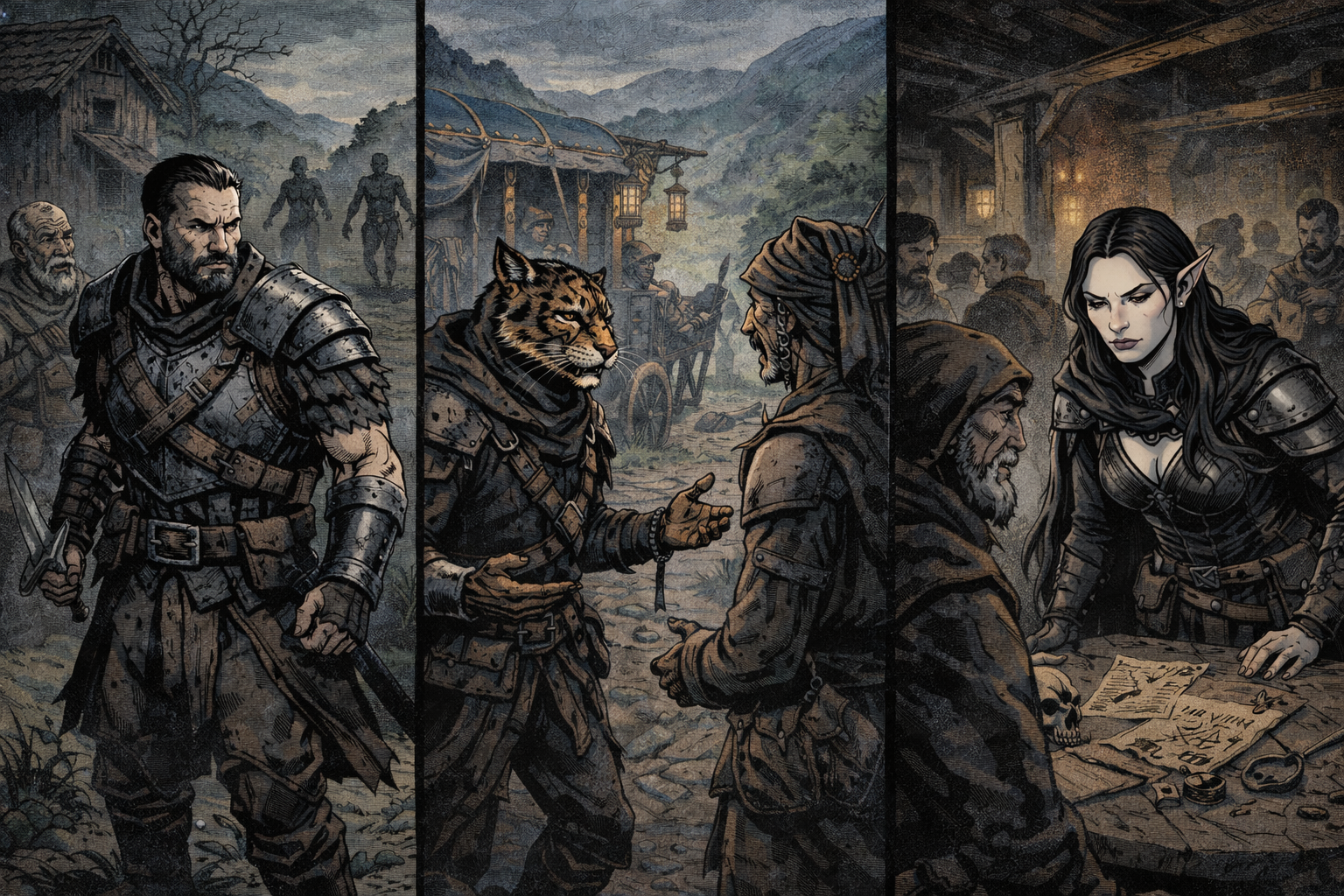
Quiet Work and Sharp Teeth
Synopsis
Campaign Note
Read aloud (optional)
“Every city has a shadow economy. Not just coin, but favors, silences, and the names of people who know things. If you want the truth, you don’t start by demanding it. You start by proving you can carry it.”
How to Run It
Run this as a single scenario with branching routes. The party is still under heat from Act I and the city investigation. Their choices here shape who helps them later and how safe the city feels when they return. The Thalmor doesn’t need to appear in person. Let it show up in hesitations, in paper that moves faster than feet, and in the way someone pays for Dwemer scrap like it’s bread.
End this scenario with one concrete lead into the main plot. It should be something physical the party can hide, lose, or have stolen. A torn inventory page, a map scrap, a sealed note. It points toward a Dwemer tablet and the words “Aethernautic Vessel,” not as lore, but as a direction.
Offer the Work
The contact does not say “go do side missions.” The contact says what the world says, in a voice that makes it sound like a warning disguised as an offer. Use Celinne Fairmontin Wayrest or Salim Jarin in Sentinel. Either way, the message is the same.
“I can put you near people who know something. But nobody risks their neck for strangers who bring heat. Solve problems quietly, and I open the next door.”
the contact
the contact
They offer three jobs. One is rural trouble the city refuses to spend soldiers on. One is a quiet city problem that must stay quiet. One is a road job that buys cover and rumors. The party can take one and leave, or chain a second if they want more coin or a cleaner lead.
Side Quest A: The Night Harvest
A small hamlet outside the city is being hit every night. Not the kind of theft that leaves you angry and hungry, but the kind that leaves you afraid to sleep. The locals whisper draugr because bandits don’t leave the bruises they found on the dead. The guard calls it bandits anyway and refuses to waste men. The hamlet offers what it can: coin scraped together, food, and a promise that if the party helps, they will have friends beyond the city walls.
Campaign Note
Read aloud (optional)
“The fields look ordinary in daylight, and that’s the trick. At night, wheat becomes a sea. Sound gets swallowed. Shapes move wrong. If something old is awake out there, it will not care what you call it.”
The hamlet’s voice is Elder Mira Tilsen, practical, embarrassed by fear, angry at being ignored. She tells the story the way frightened people tell stories. She repeats the parts that feel controllable.
Elder Mira Tilsen : “We asked the city once. They said we were wasting their time. So we scraped our own coin. That’s what’s left.”
Beat 1: Daylight
In daylight the hamlet looks ordinary, and that is the cruelty of it. Wind-bent fields, low houses, a barn that smells of damp hay and worry. Let the party walk the damage while people pretend not to hope too hard. Broken stalks and trampled lines, then the first wrong note: the pattern is too clean. Not a scramble, a route. A barn lock opened gently instead of smashed. Someone knew which nails to pull without waking the whole place. Then the detail that changes everything. The raiders aren’t taking food. They are taking supplies that build something: rope, lantern oil, iron nails, tools. And they took one small coffer of “worthless” Dwemer fragments that Hadrin Sel kept because it felt older than anything out here.
Hadrin Sel : “It was junk. Just metal that doesn’t rust right. I kept it because it felt… older than anything out here.”
Beat 2: The Watch
The sun goes down and the hamlet becomes a held breath. The party chooses how they want to be invisible. A roofline buys sight but steals cover. A barn loft buys cover but steals movement. The wheat buys silence until you shift wrong and the whole field whispers. Their plan matters here. A careful setup buys them the first clean move. A sloppy setup buys them panic. The villagers can help with lanterns and quiet hands, but they are witnesses. If they fight, it is because terror forced them into it.
Beat 3: Night
Night falls, the wind shifts, and then something moves. Keep it quiet at first: a soft clink of metal, a lantern flame covered, a shadow that doesn’t silhouette correctly. Then make the intention clear. The intruders aren’t wandering. They are navigating, straight toward what they came for. If you want disciplined raiders, use Ronvek. He keeps his people tight and pulls them back when the job turns loud. If you want restless dead, make it one or two figures with the wrong kind of purpose, drawn toward Dwemer metal like a bell. Either way, keep the clash local and messy. Wheat catches. Mud grabs boots. Someone runs the wrong way. The party wins by controlling the chaos, not by turning the hamlet into a funeral. When it’s over, pay them in proof. Give them one physical lead that points away from the hamlet and toward something older. A smudged note about a ridge-marker rendezvous. A private wax token. A map scrap with an old mountain route and the words “Intake shaft.” If you want the Dwemer thread to bite harder, add a single line copied by someone who doesn’t understand it: “Tablet: Aethernautic Vessel.”
Side Quest B: The Tavern That Won’t Forget
Back in the city, Bren Kastor wants a problem solved quietly. Coin purses vanish without belts loosening. A back door is always found shut at dawn, yet something uses it at night. A regular swears he saw a man who wasn’t in the room. The guard would turn this into arrests and questions. Questions are dangerous when the party is already hot.
Campaign Note
Read aloud (optional)
“An inn is a confession booth with better lighting. People talk when they drink, and people steal when they think nobody will notice. But the strangest crimes aren’t committed for coin. They’re committed for leverage.”
Beat 1: The Ask
Bren doesn’t plead. He negotiates. A room, a meal, a small purse of coin, if the party handles it without noise. He offers something more valuable than coin. Discretion. If they help, he stops asking questions.
Beat 2: The Pattern
Let the party sit with the room long enough to feel its rhythm. The common room is warm, loud, ordinary. That ordinariness is the cover. Someone always sits near the back door. Someone always orders the same drink and never finishes it. Someone always arrives a little before the thefts begin. Let Perception and social skill work like pressure, not like a riddle. The goal isn’t a perfect deduction. It’s the moment when the pattern breaks.
Beat 3: The Mechanism
Keep the mechanism small-scale but sharp. A hidden latch in the doorframe. A small Illusion charm that makes witnesses disagree about faces. A traded trinket that makes people careless with their belongings. When the party corners the culprit, it’s not confidence they find. It’s fear, the kind that makes a person talk too fast and lie badly.
Kesta Rook : “I wasn’t stealing for fun. I was paying. You don’t say no to people who wear clean gloves.”
Kesta wasn’t stealing for greed. Someone paid for information, and what they wanted wasn’t coin. They wanted descriptions. Travelers asking about Dwemer artifacts. Travelers asking about Ammar al-Rihad. Anyone carrying sealed papers. The tavern wasn’t being robbed. It was being watched. Before she runs or breaks, she gives one lead that matters. Don’t offer a menu. Offer one clean thing the party can act on. A meeting place in a back room. A rubbed catalog page with one entry circled. Two words she repeats like she doesn’t want them in her mouth: “Aethernautic Vessel.”
Side Quest C: The Caravan Through the Pass
A caravan needs guards through a dangerous pass. The pay is decent, and the offer that matters is discretion. Roads have their own politics. The bells are muffled with cloth. The spices and leather smell like money. Everyone is polite because nobody wants trouble to have a reason.
Beat 1: The Contract
Put Ra’zzir on the road if you want continuity. In daylight he looks less like a rumor and more like a professional. He pays in coin, but what he offers is cover: a place in the flow of people where questions don’t stick.
Ra’zzir : “Coin is coin. The road is not. On the road, you pay with silence.”
Beat 2: The Pass
Give them one clean problem on the road and make it feel like a test of restraint. A blocked path. A rockfall that looks natural until you see the tool marks. A shape on a ridge that stays still a little too long. Keep it tense and practical. The party’s job is to get the caravan through without turning it into a story people repeat.
Beat 3: The Tie-Back
Don’t lecture. Let the road do the revealing. A crate clinks wrong, and inside is Dwemer metal wrapped like contraband. Someone asks about tablets with the kind of politeness that hides a threat. The caravan’s rumors point one way: a Dwemer place in the mountains that was opened recently, and people who went in did not come back. End with something the party can keep. A stamped shipping tag. A torn inventory line. A route name that matches the scrap from the hamlet.
How It Leads to the Main Plot
No matter which jobs you run, end with one clear direction. The party shouldn’t leave with “more lore.” They leave with a place to go next and a reason that feels urgent.
That direction comes from one physical lead. An inventory page naming a Dwemer tablet. A map fragment that marks an intake shaft. A sealed slip with a date and a waypoint. It doesn’t matter which one you choose as long as it can be carried, hidden, and fought over.
Celinne : “You don’t find the truth in a city. You find the shape of the lie. Then you follow it into places where nobody lives.”
Ending
Close on motion. The party has earned coin, breathing room, and a real arrow pointing forward. Somewhere in the mountains, there is an old Dwemer place that the world forgot for a reason, and something inside it speaks of a vessel not meant for seas.
As they prepare to leave, show the city adjusting around them. Not with drama, but with quiet coordination. They have been noticed, and the notice has already become paperwork, whispers, and a decision made somewhere behind a closed door.
Campaign Note
Last pressure beat (pick one)
Option 1: The watcher. The party spots the same face twice in two different streets. When they turn to confront it, the watcher is already gone, but the feeling stays: someone is mapping their routes.
Option 2: The polite door. The party tries to ask one last question at a scholar’s house or a clerk’s stall. The answer is a door closing gently and a voice from inside that says, “I can’t be seen with you.” The city didn’t become hostile. It became careful.