The road finally stops being social and becomes stone. Everything the party has gathered in the city, every rumor that turned into paper, every nervous glance from scholars, points toward an ancient place that holds the first real key to the mystery. This is not a dungeon meant to be conquered by damage. It is a place meant to be survived by attention, caution, and choices. Dwemer ruins do not punish weakness. They punish carelessness.
← Back to Act II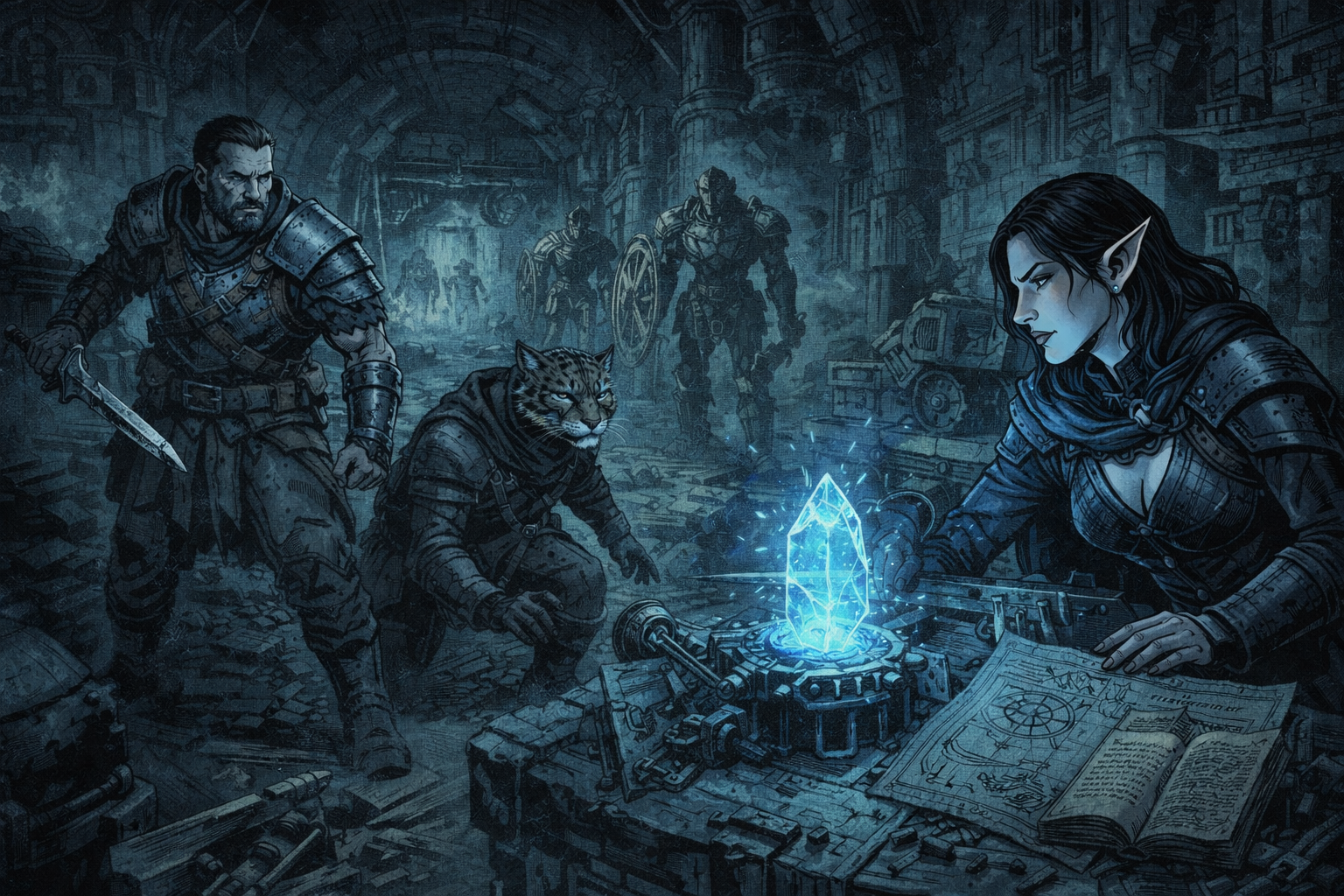
The Hollow Brass
Synopsis
Campaign Note
Read aloud (optional)
“You learn the difference between rumor and truth the moment you put your hand on old stone. Rumor talks. Truth waits. Truth is heavy. When you find it, it changes the shape of everything behind you.”
The hook that sends them here
The lead should arrive as something physical. It folds. It stains. It can be hidden inside a boot, or stolen from a pocket. If you ran the city investigation and the side jobs, this is the moment the threads tighten into one direction. Use one clear version. A torn catalog page with a single entry circled: a Dwemer tablet that “speaks of an Aethernautic Vessel,” last seen in a private collection that moved into the mountains. A charcoal rubbing taken from a half burned ledger, a stylized glyph that the right mind reads as “Void Sailing.” A rumor traded quietly by Salim Jarin or confirmed with a thin smile by Celinne Fairmont : someone in fine gloves has been hiring guides to a ruin locals call the Hollow Brass.
Optional line (the contact): “If the Thalmor wants it, it means it works. If it works, it means the Dwemer weren’t dreaming. They were building.”
The important part is urgency. The party is not the only one heading there. The Thalmor has interest in the same place. You do not need a fight at the entrance to create pressure. You need the sense that every hour makes the world more likely to arrive before them.
The approach
The mountains are not dramatic. They are indifferent. Wind steals heat. Rock steals ankles. Narrow passes carry sound farther than it should travel. Snow survives in shade even when the sun is bright. The Hollow Brass survived because it is inconvenient, and because the land around it feels subtly wrong. A faint metallic tang in the air. Stones that ring strangely underfoot. Birds that avoid a certain ridge as if it offends them. Place it to match your chosen city. If you are running Wayrest, set the approach in hard, wet highlands where fog clings to stone and every path becomes mud. If you are running Sentinel, set it in dry mountains where wind scours everything clean and footprints become an accusation. If you want the approach to have a human face, use a guide. Yara Stonepath does not sell bravery. She sells routes. She tells them where rockfalls happen, where patrols sometimes camp, and where the air tastes wrong. She also makes it clear what this costs.
Yara Stonepath : “I can get you to the ridge without dying. What you do after the brass starts humming, that’s yours.”
When they finally find the entrance, it should feel like discovery, not arrival. A half buried Dwemer arch, brass edges dulled by weather. A seam in the cliff that is too straight to be natural. The door is closed in the way a machine closes. It has a purpose that does not include them.
The ruin
Dwemer spaces do not feel haunted by ghosts. They feel haunted by intent. Angles too precise, mechanisms too quiet, corridors too clean. Light reflects off brass and stone with cold clarity. Sound behaves badly. It is swallowed in one corner, amplified in another, as if the walls are listening and deciding what to keep. Structure the dungeon in layers, even if you never draw a map. First the Outer Works, where traps and maintenance systems still function. Then the Hall of Custody, where guardians remain. Then the Heart Workshop, where the revelation waits among tools that were never meant for mortal hands.
How to run it
Keep the rhythm classic: advance, observe, test, commit, pay. Every corridor asks a question. Move fast and risk traps, or move slow and give the ruin time to wake. Clever solutions should feel clean. Force should be allowed, but costly. Combat should be dangerous without becoming constant. The Dwemer does not flood you with enemies. It places guardians where they matter and lets the ruin do the rest. Use skill checks as texture. Perception does not “find the trap,” it notices the wrongness that lets the party respond. Lockpicking buys time and avoids noise. When someone fails, do not stop the dungeon. Let it bite and keep moving.
Play sequence (beats)
Beat 1: The Brass Threshold
The entrance corridor slopes down into darkness with a faint humming under the stone, like a distant machine dreaming. The first chamber is small, almost polite. A brass panel sits in the wall beside an inner door: five narrow chime-bars arranged like a simplified instrument, each etched with a Dwemer “tone” glyph. When the party steps fully into the room, the hum resolves into a short motif that repeats on its own every few breaths: three tones, then a pause, then the same three tones again. The ruin is telling them what it wants. Run it like this: to open the inner door, the party must reproduce the three-tone motif by tapping the matching chime-bars in the correct order, then waiting through the pause. Let attention solve it. A character who listens closely can identify the pattern (WIS/Perception), and a character who understands Dwemer tonal design can map glyphs to pitch (INT/Arcana or History). If they play it correctly, the panel answers with a clean, harmonious chord and the inner door unlocks with a quiet, satisfied click. If they play the wrong bar, play the right bars in the wrong order, or rush the pause, the panel replies with a harsh, dissonant buzz and vents steam in a short burst. It is not lethal, but it stings eyes and throats, and the sound carries deeper into the ruin like a bell rung in a sleeping hall. Each failure should cost something: time, noise, or a small resource, and repeated failures can justify waking a minor construct later or making the next defense “already listening.”
Beat 2: The Corridor of Blades
The next corridor is long, straight, and subtly wrong. Floor plates are patterned. Wall holes sit at ankle height. A Dwemer trap does not announce itself. It waits for rhythm. Make the rule readable. If the party moves cautiously and watches the floor, let them notice that some plates are slightly proud of the others, raised just enough to catch boot leather, and they ring a fraction higher when tapped. Every third plate in the repeating pattern is the trigger; the wall holes align with those plates. Step on a trigger plate and blades scissor from the walls at shin height in a fast two-second sweep, then retract. It is brutal, efficient, and designed to punish marching, not thinking. Run it like this: the corridor is a test of movement discipline. Give them options that feel fair: probe with a pole, mark safe plates with chalk, send the lightest person first, or go slow as a group with a single shared check. If they learn the pattern, they can cross cleanly. If they trigger the blades, let it be a consequence they can manage (damage, bleeding, noise), not a dead end. If you want a complication, trigger the blades twice and have the far door begin to iris shut. Now they have to cross while staying calm: solve the small brass access hatch to disable the sweep, dash and accept a risk, or retreat and spend time finding another route. Either way, the ruin learns the sound of them.
Beat 3: The Percussion Junction
Three passages branch, each sealed by a brass iris door that has no visible handle. Above each door is a simple mark in Dwemer style: a point, an empty circle, and a filled circle. In the center of the junction stands a waist-high brass plinth with a flat striking surface that feels like a drumhead made of metal. A Dwemer junction is routing, not architecture; it does not ask “which way,” it asks “which signal.” This is the percussion puzzle. The plinth reads vibration, timing, and intensity. The clue is right there: the three door-marks repeat as a tiny sequence carved into the rim of the plinth (point → empty circle → filled circle), and the hum of the ruin behaves like a metronome if they stop and listen. Run it like this: to open a door, the party must “speak” its mark on the plinth. Point means tap once, light and precise. Empty circle means tap once, then hold silence and do nothing until the humming dips (a short beat of quiet). Filled circle means strike once,hard, then wait as the mechanism cycles (a longer beat). If they perform the correct gesture for a door, its iris unfurls with a smooth, satisfied whirr and the others remain sealed. If they rush the silence, double-tap, or strike with the wrong force, the plinth answers with an angry clack and the junction “listens” harder: a brief alarm tone that can justify a guardian waking later, or an immediate pressure vent that makes the room unpleasant but survivable. There is no correct path, only chosen risk; the puzzle makes the choice feel deliberate.
Beat 4: First Guardians
Eventually they enter a small hall where brass and stone form clean geometry. A circular inlay sits in the floor. At its center rests a dormant Dwemer sphere or spider, folded and still, like a resting animal that is not an animal. Trigger it when the ruin decides it is time. Touching a console. Crossing the circle without disabling a pressure plate. Lighting a torch too close to a sensor crystal. Or simply time, if the party has been loud. When it wakes, describe mechanical grace. Clicking limbs. Smooth rotation. A sudden burst of steam and motion. Keep it short and sharp. One or two constructs, not a swarm. Reward the fight with something practical. A vial of Dwemer oil. A gear that can serve as a tool. A brass rod that fits certain access points later.
Beat 5: The Hall of Custody
Past the outer works the ruin opens into a chamber with a high ceiling lost in shadow. Brass piping runs along the walls like veins. At the far end sits a sealed door with a glyph plate that looks like a lock and a warning. Three pedestals hold inert metal cubes etched with different symbols. The door bears those same symbols in a ring, with empty sockets. The obvious answer is to place the cubes. The danger is that each cube punishes handling. One vents steam when lifted. One tugs at metal, yanking tools and buckles into a clatter. One is safe but heavy, requiring cooperation. If the party bypasses the puzzle through a side maintenance hatch, make it narrow and make it bite. A floor piston slams down if weight is placed too evenly. They learn quickly that the Dwemer punishes patterns as much as it punishes speed.
Beat 6: The Centurion
When the door opens, the air changes. Drier. Older. Charged. The main hall is a gallery of alcoves containing dormant Dwemer centurions. Statues until they are not. At the far end the Heart Workshop door leaks faint blue light through seams like trapped starlight. This is a threshold guardian moment. Do not wake every centurion. Wake one. If the party has been loud, wake two. Describe weight and inevitability. Brass plates shifting. Steam venting. A deep sound like a giant inhaling. Give the party tools in the environment. Chains. Vents. Levers. A partial gate. Let them win by thinking, not by standing in open ground trading blows. If you want a puzzle inside the fight, add a power conduit on the wall. Disable it and the centurion’s arm slows for a round. That reward makes the party feel clever without turning the scene into a minigame.
Beat 7: The Heart Workshop
The Heart Workshop is not locked. It is sealed by a mechanism that responds to presence. As the party approaches, glyphs flare faintly and the door exhales a soft hiss, like a machine deciding to allow intrusion. Inside, the space feels less like a ruin and more like a paused moment. Deliver the revelation without a lecture. Technomagical benches. Brass instruments. Half finished components that look like they belong to a ship and a spell at the same time. Metal plates etched with diagrams of curved hull segments and rune logic arrays. A core framework labeled in Dwemer script with a term that reads, in imperfect translation, as “Void Sailing Chassis.” Aetherium appears as fuel and stabilizer, not as decoration. The Dwemer were not building a flying boat. They were building something meant to sail the Void. On a central pedestal rests the object they came for: a Dwemer tablet etched with text and schematic glyphs. The phrase is there, unmistakable once translated or even partially recognized. Aethernautic Vessel. Not myth, specification. Nearby place two treasures that change the campaign. An Aetherium Fragment, small and bright blue, cold in the palm and humming like a held note. A metal bound journal describing refinement, stability, navigation, and routes. Routes, written like logistics. That is the terrifying part.
Optional journal line: “We do not rely on magicka. Magicka is a tide. Aetherium is a rule. The vessel must obey rules, or it will be swallowed.”
Beat 8: The exit that proves they aren’t alone
When they take the tablet, the ruin responds. Not with collapse, but with awakening. The hum deepens. Lights flare in pipes. Somewhere far away, a construct moves. The party does not need to see the pursuer to feel the pressure of it. End with one clear truth. They came for answers and found a blueprint. That is worse. A blueprint means someone can rebuild what should have stayed buried. Decide how hard the ending bites. A soft ending is escape as the ruin wakes behind them, chased by sound and rising heat, emerging into cold mountain air with the tablet and fragment. A hard ending is proof of another presence. A fresh boot print in dust that does not match theirs. A cut rope. A fine glove dropped and left behind. A scrap sealed with a private mark that feels familiar, the kind of mark you would expect on a polite letter. Not a fight, just certainty. The Thalmor is not only interested. It is moving.
What the party learns
Keep it concrete. The tablet confirms the existence of an Aethernautic Vessel, a void sailing craft powered and stabilized by aetherium. The workshop plans and journal prove this was engineered, with routes and parts described like logistics. The Thalmor interest now makes sense. They are not chasing this to understand it. They are chasing it to use it.
Close on one image that points forward. The Aetherium Fragment humming faintly in a pocket. The tablet wrapped in cloth like a stolen heart. The mountains behind them holding the ruin in silence again. In the city, someone will be turning pages with clean gloves and an even cleaner smile.