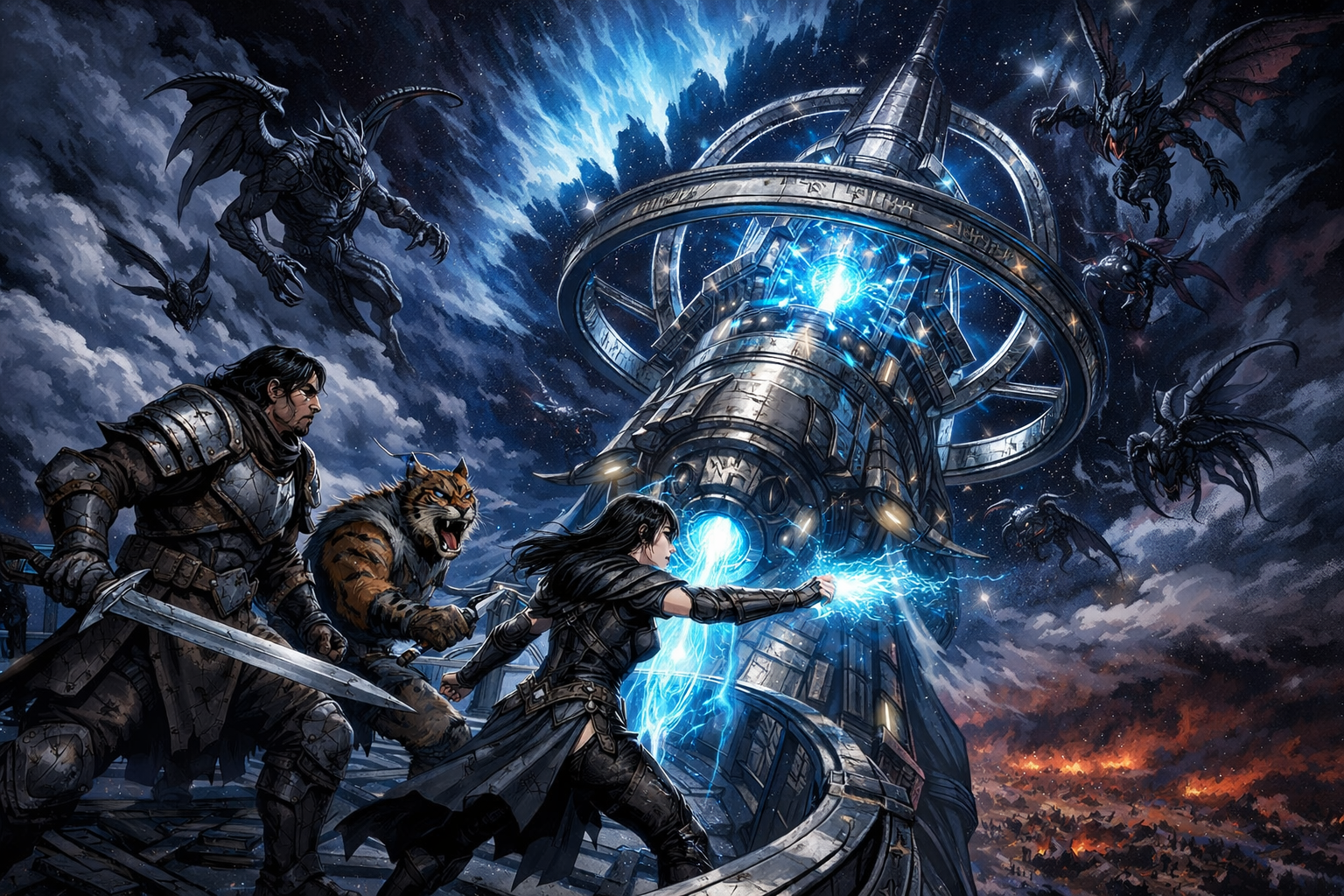
Beat 1: The Storm Pierced
The launch is immediate and violent. The Hope of Cyrodiil climbs into a storm that looks like it was built to forbid ascent. Lightning forks around the hull, not striking at random but finding the ship’s edges as if the sky resents being cut. The wind hits like a wall. The mages tighten the weave, and the aetherium core answers with a pulse that turns the ship’s brass seams pale-blue for a heartbeat.
Give the party something to do at once. A deck line snaps and whips like a serpent, threatening to throw someone overboard. A hatch refuses to seal. A ward sigil flickers under strain. Let the first hundred meters be earned the hard way, with hands on rope and metal and quick magic that tastes like fear.
Beat 2: The War Below
For a moment, the storm thins, and the world opens beneath them. Fires are tiny, distant, like embers on a dark cloth. Formations move like ants. Siege engines are pins. The scale shift lands hard. Below, thousands die because that is what empires do when they panic. Above, the ship climbs into a place where death might not even be the worst outcome.
This is the last clean look at Tamriel. Give it weight. Then take it away. The clouds close. The air thins. The sound of war fades until the only constant is the ship’s hum and the party’s breathing.
Beat 3: The Edge of Orbit
Reaching the edge is not triumphant. It is quiet in the wrong way. Frost blooms along brass as if cold is a creature that has found something new to eat. Flames behave oddly. A candle leans without wind. Droplets hang too long before falling. The ship creaks as though the metal is remembering a different set of rules and trying to decide which ones to obey.
Call for the first real discipline here. The horizon curves and the mind tries to reject what it sees. The ship feels smaller, and the sky feels larger, and the body wants to pretend this is only a dream. Success is steady hands. Failure is a brief shiver of cosmic dread, a moment where breathing feels like an argument.
Beat 4: The Void Crossing
Then the ship crosses, and the darkness changes texture. It is not night. It is the Void, and it presses close enough to be felt in the teeth. The stars sharpen into breaches, bright punctures of Aetherius in the black, not lights hanging far away but openings that make the darkness around them seem heavier by contrast. The mages speak less, not because they have nothing to say, but because words feel loud here.
This is not a portal with a frame. It is gradual wrongness, a borderland where Oblivion is close enough to breathe on metal. The aetherium core hums louder, and the hull answers with faint vibrations that sound like distant chanting if you listen too long.
Beat 5: Imps Between Breaches
The first attack arrives like a thought that isn’t yours. A breach flares, not brighter but nearer, as if distance collapses for the length of a breath. Something small pours out of that light in a flurry of needle wings, a cloud of lesser Daedra that looks almost ridiculous until it touches metal. Imps of Oblivion, little and winged, quick as sparks, their faces too expressive for something that should not be able to exist here. They do not roar. They do not announce themselves. They attach.
They go for ward nodes first, because wards are what keep the Void outside. They chew at seams like termites. They pick at sigils with claw-tips that feel like cold hooks. Then they go for the mages holding the weave, because collapsing the minds that hold the persuasion is simpler than breaking the brass.
Beat 6: Combat Under a Starry Wound-Sky
This is the signature scene. The deck is slick with frost. The horizon is not a horizon. The stars are too bright and too still. The imps cling to the rails and swarm the vulnerable points with surgical greed, a dozen small bodies doing the work of one serious threat. Spells cast into the void leave pale scars of light that linger a heartbeat longer than they should, as if the darkness remembers being hurt. Steel feels smaller here, but it still matters, because a clean cut is a clean rule.
Make the fight about more than damage. Each exchange threatens the ship’s integrity. A creature tears at a ward plate. A claw wedges into a seam. A mage staggers, blood from the nose, struggling to hold the weave. The party can win by killing, but also by pushing attackers off critical points, sealing a hatch, reinforcing a sigil, dragging a wounded mage away from the core’s pulse.
Layer in the mind effects without turning it into noise. A party member who stares too long into a breach feels a cold pressure in the skull, the sense of falling without moving. Grounding is physical here. Touch metal. Speak a name. Look away. Remember you have weight.
Beat 7: The Void Boss
When the swarm starts to break, the Void answers with something that is not small. One of the breaches widens like a wound being reopened, and a figure steps out as if stepping down a stair you cannot see. A Dremora kynreeve, armor etched with runes that drink light, a commander’s posture in a place that should not allow posture. Around him, a cloak of torn darkness moves like wings when he turns, and the air near him tastes like ash and old oaths. He does not scramble for purchase. He reaches for the ship’s wards with certainty, like someone signing a document.
He is the boss of this crossing, not because he is the strongest thing in the Void, but because he knows what he wants. He wants an anchor. A single hooked glyph placed on the hull so the next breach can find the Hope of Cyrodiil again, later, when the party is tired and the sky they left behind is far away. If he can touch the core chamber’s boundary, even once, he will leave a mark that behaves like a map.
The fight changes texture. This is not swatting pests. This is stopping a deliberate act. Let the party win through force, through clever wardwork, through a risky shove that sends him tumbling back into the breach, or through severing the anchor glyph before it can take. If they fail, the ship still limps onward, but it does so with a promise clinging to its brass, a future attack already scheduled.
Beat 8: Navigation Through Non-Space
When the predators are driven off, the Void does not reward them with peace. It simply becomes quiet enough that navigation becomes the next threat. Here, direction is not only direction. It is alignment. The ship must find the lunar signature in a sky full of openings and resist drifting toward the wrong kind of attention.
This is where a person can become the price. If Irius survived the bastion, he can call the alignment in a voice that tries to sound like instruction instead of prayer, naming the pull the way sailors name tide. But it is Helvion who has to go where the ship is most vulnerable, down to the ward nodes and the seams that are still warm from hurried work, because someone has to make the correction physically true.
If the party keeps a line on him, keeps him anchored, keeps him from slipping when the deck forgets what up is, Helvion lives and the ship answers cleanly. If they do not, the Void takes him in the least dramatic way imaginable, a boot that finds no grip, a slow drift toward a breach’s cold light, a hand reaching for a rail that is suddenly too far away. The ship still reaches Masser. It reaches it with one less pair of hands that could make reality behave, and everyone aboard will hear the absence in the hull’s next wrong note.
Success means the crew locks onto Masser’s pull, and the oppressive pressure eases as if the world has decided the ship belongs somewhere again. Failure still reaches the goal, but it carries a cost that follows: damaged wards, exhausted mages, lost time, or a subtle hitchhiker clinging to the hull where nobody thinks to look yet.