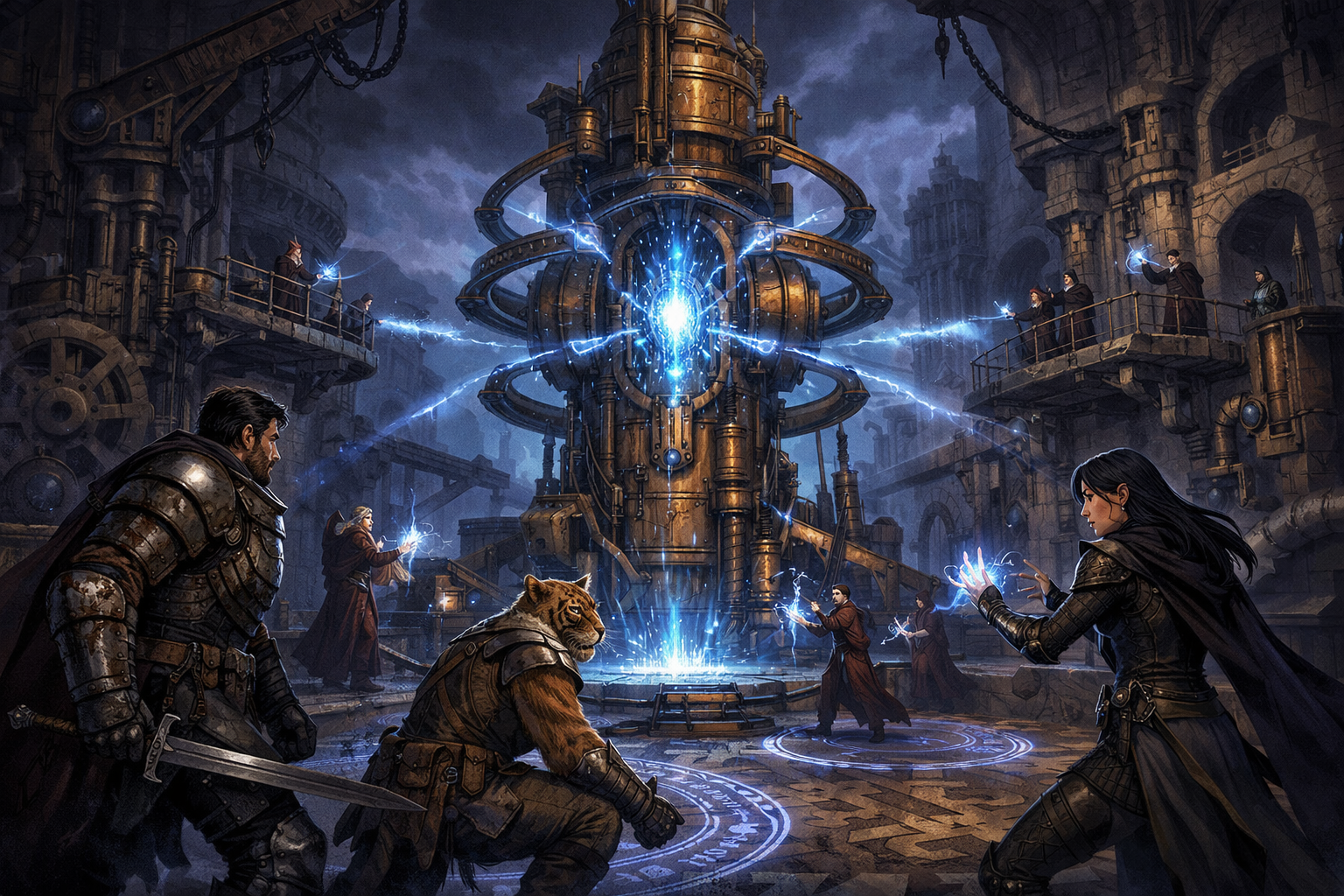
Beat 1: The Three Missing Parts
Irius Quill names the parts without romance. The aetherium bridle, a Dwemer geometry frame that keeps the core from singing too loud. The navigation schema, a chartage of lunar resonance that treats the stars as thresholds instead of lanterns. The wardglass plates, a skin of sigils and glass that turns Oblivion into pressure mortals can bear.
Beat 2: Mission One, Vilverin
The bridle is hidden inside the Ayleid ruin Vilverin. Welkynd light turns the corridors pale and wrong. Traps punish confident movement. Then the dead answer, not as wandering ghosts, but as Ayleid ward-things, proud and hateful, rising in cold light to defend a place built for cruelty.
The objective is not to clear Vilverin. It is to reach the chamber that was never meant to hold Dwemer metal and take the bridle out alive. The party learns quickly that Ayleid guardians do not fight for territory. They fight for denial. They fight to keep a door closed, even centuries after the hand that built the door stopped being a hand.
The bridle rests in a Dwemer-lined case inside an Ayleid chamber that was never meant to hold Dwemer metal. Taking it feels like pulling a tooth from a sleeping mouth. Vilverin offers no neat confession, no convenient clue, only the certainty that the ruin was built to keep hands out, and that the party just put their hands in anyway.
Beat 3: Return One
The bridle is installed. The core’s hum drops into a steadier note. For a moment, the ship seems to agree. Then the party can notice a small wrongness that is easy to dismiss. A bolt looks freshly handled when nobody admits to touching it. A tool is returned to the wrong rack, not missing, just wrong. A seal impression looks pressed twice.
This is the first chance. If the party catches it, they stop the harm while it is still cheap, and they start a list of details that will matter later. If they do not, the work crew tightens what Irius tells them to tighten and moves on, and the ship keeps the mistake like a splinter: a clamp that will sing under strain, a seam that will flex when it should not. It will not kill them today. It will make tomorrow louder.
Beat 4: Mission Two, The Forgotten Library
The schema is buried under the Imperial City in a forgotten library because paper is safer when it is underground. The party descends through wet stone corridors where marble gives way to older fear. Shelves bow like tired backs. Dust is thick enough to be a record. The dead drift between aisles like obligation, clerks and scholars who died with ink on their fingers. They whisper names.
The objective is to leave with one thing: a usable sky-route. Not lore. Not history. A schema that treats stars as thresholds. The ghosts do not stop them out of malice. They stop them the way paperwork stops people: by insisting that you do not belong where you are standing.
The schema is held behind a pattern-lock that responds to correct naming, not force. Solving it feels like scholarship with a blade half drawn. When the schema is taken, footsteps echo behind the party once, then stop, as if someone decided not to be seen. The sabotage does not chase. It schedules.
Beat 5: Return Two
The schema is seated. The hull’s tone shifts, as if the ship learns the difference between sky and door. And again, a small wrongness tries to pass as exhaustion. A chalk smudge where there should be none. A ledger line rewritten in a hand that is almost the right hand. A messenger who leaves a room too quickly with nothing delivered, as if his work was timing.
This is the second chance. If the party connects it to the first wrongness, the pattern stops being a feeling and becomes a suspect. If they miss it again, the ship begins to learn the wrong lesson. It still knows “door,” but it answers late. It drifts. It will still fly, but it will spend more of itself doing it.
Beat 6: Mission Three, The Black Marsh Cache
The wardglass plates are not where the party first assumed they would be. They were moved. Not for convenience, but for survival. When war turned the Imperial City into a place where secrets evaporate, the Synod did what it always does when it is afraid. It hid the dangerous work somewhere that looks like it eats people. South and east, past the polite roads, near the border where Cyrodiil rots into Black Marsh, there is an Imperial-era field cache half sunk in peat, a stone bunker sealed with runes and old receipts, built to be forgotten and then used only when the world runs out of options.
The Third Dominion has found it. Not the whole machine of an invasion, but a sharp unit, Thalmor operatives with clean boots wrapped in swampcloth, moving like people who have been trained to treat discomfort as irrelevant. Their goal is not research. It is possession. They want the plates because wardglass admits the Void is real, and the Dominion prefers the kind of reality that can be edited without witnesses.
The objective is not to prove a point. It is to leave with plates intact and aligned while the swamp tries to pull everything down and the Dominion tries to pull everything away. Wardglass is protection that behaves like math. One misaligned plate is not a crack you can patch later. It is a future failure that waits for pressure. The plates must be lifted as a set, kept level, kept clean of grit that will become a fracture under strain.
Make the opposition feel like war at a smaller scale, the kind of war that happens before banners arrive. Dominion scouts in the reeds. A Justiciar’s calm voice behind a mask. Wards set as tripwires over black water. If the party goes loud, the swamp answers too, insects rising in clouds, visibility turning into a weapon. If they go quiet, the Dominion answers with patience, letting them do the hard work and then trying to take it in the last ten steps.
Beat 7: Return Three
Wardglass is installed. The hull feels like it has a skin. The air in the drydock changes, as if the ship is now a real thing the world must account for. That is when sabotage stops practicing and tries to become fate. A reversed glyph on a panel. A clamp weakened, ready to snap on the first surge. A tonic diluted, turning a steady mage into a collapsing body.
If the party kept the details from the three returns, they have a chain of small truths that becomes a net. Double seal. Chalk smudge. Wrong tool placement. Ledger line rewritten. One detail is coincidence. Three details are a hand. A hand belongs to someone. Caeso Vibius closes doors without making a scene, because scenes are how saboteurs turn into martyrs.
The saboteur is Lucan Meroval, polite enough to be terrifying. He is not trying to stop the launch. He is trying to make the launch fail later, far from witnesses, so the Void takes the blame and the Empire takes the burial. Whether he serves the Dominion or a terrified idea of Imperial purity, his intention is the same: turn the ship into an accident that looks reasonable.
This is the third chance. If the party catches him here, the confrontation is short and close, among scaffolds and cables where one wrong spell can rupture a conduit. If they do not, he does not need to win a duel. He only needs to leave the damage in place. The ship will still launch. It will launch with consequential instability, and everyone aboard will feel it the first time the world stops being sky.
Even if the party catches him, this is where the cost starts demanding a name. A conduit that should hold flares under strain, and the core answers with a hard, bright pulse. Irius Quill reaches for the pattern because he cannot help himself. He is the one supervising the work, the one holding the argument together in his head, and in the surge he tries to keep the ship coherent with bare will and faster hands than a mortal should trust. If the party acts fast, they can drag him back, ground the flare, and leave him alive with burns and a tremor that will return whenever the hull hums. If they hesitate, the pulse takes him where thought meets light. The launch still happens. It simply happens with less guidance, and the ship learns to rely on procedure instead of the one mind that understood its whole argument at once.
If the saboteur escapes, Lucan Meroval escapes into bureaucracy and the noise of war. That is his preferred terrain. If he is caught, he does not confess with drama. He offers a justification that sounds like a report and feels like blasphemy, and that is how the party knows they found the right kind of enemy.
Caeso Vibius : “People think sabotage is noise. The best sabotage is a correction nobody notices until it’s too late.”
Beat 8: The Briefing
The mission is delivered without ceremony, because ceremony dies fast in an apocalypse. Primary target: Masser or Secunda. Find the pylon, the keystone, the lunar anchor that can affect a titan tied to Lorkhan’s power. Secondary target: if the lunar route fails, find an angle armies cannot touch, an Aedric artifact, an intervention, an answer above the war’s ceiling. They are not hunting a weapon. They are hunting a switch, and the idea of a switch for Numidium should feel wrong in the mouth.