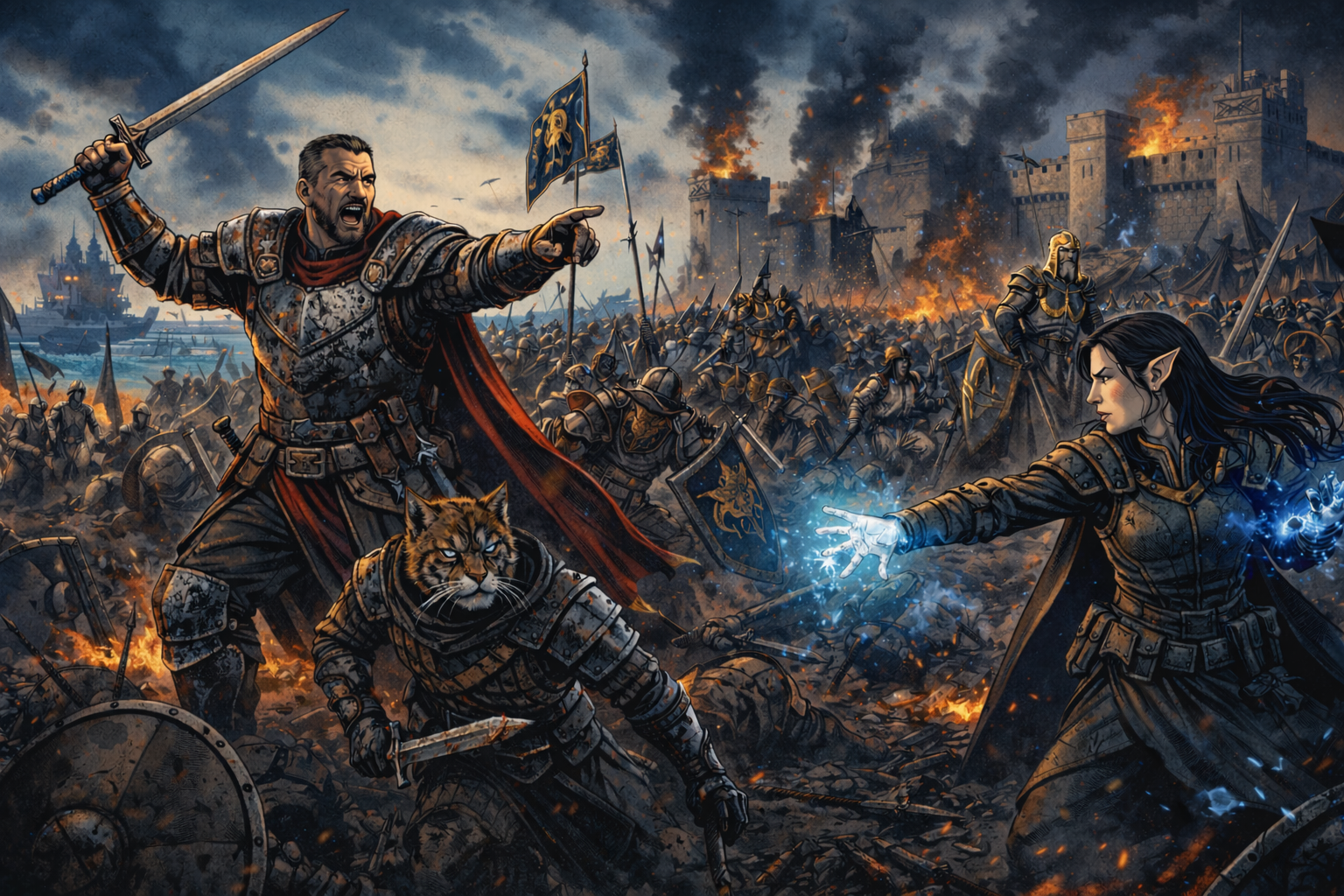
Beat 1: The Alarm
The summons comes in the language of urgency, not ceremony. Caeso Vibius finds the party with a sealed dispatch and eyes that do not blink enough. The order is simple. The Dominion is at the coast. The walls will be tested before nightfall. The party is assigned immediately, not because they are famous, but because someone has decided they are reliable under pressure, which is the rarest commodity in war.
If the city has become personal, let the dispatch make it smaller. A commander’s name they heard in the White Gold Tower. A dock district where Salim Jarin once kept a room for quiet meetings, or where Celinne Fairmont has a contact who can make paper lie. A street they walked yesterday, now marked for evacuation. War turns maps into knives. Everything feels close.
Beat 2: The Choice of Mission
The staging area already smells like iron and fear. The party meets an officer whose voice is clipped and tired and real. Captain Olvar Reet does not waste words on heroism. He speaks in tasks because tasks are what keeps people alive. He offers them two routes into the same disaster, two ways to be useful in a city that is about to burn.
One path is visible. Hold the line at a breach point in the docks, a gate corridor, a narrow street where the Dominion is pushing hard. They take charge of a mixed squad: legionaries with dented shields, militia with shaking hands, and maybe one combat mage if the Empire is desperate enough to gamble on exhaustion. The job is not to win the war. The job is to hold for a span of time so evacuation, reinforcement, or a counter-move can happen.
The other path is quiet. Cut the heart behind the front. Sabotage ballistas. Burn siege stores. Collapse a supply bridge. Sever a signal that coordinates Thalmor movement. Smoke and locked doors and the constant risk of being trapped when the lines shift and the city changes shape around them. The work of knives, done inside a storm.
Beat 3: The Battle as a Moving Dungeon
The battlefield refuses to be a stage. It behaves like weather. Streets become corridors whose exits change. Fire falls like punishment. Stone collapses without warning. Water on cobbles is relief and hazard. Smoke is concealment until it is blindness. A side alley offers cover and then dead-ends into civilians trapped behind a jammed door. A rooftop grants line of sight until a ballista bolt arrives that does not care about height.
If the party holds the line, the fight becomes about position and morale, about shields and choke points and retreat routes, about wounded men screaming for help while the next wave arrives anyway. This is whereSergeant Dalia Cassia can re-enter their lives like a ghost that refuses to stay in the past. If she survived Act I, she is here now, soot on her cheek again, eyes bright with the same exhausted clarity, holding a squad together by refusing to pretend this is anything but ugly.
If the party cuts the heart, the dungeon grows sharper. Service doors are locked because locked doors slow panic. Thalmor sentries do not shout warnings. They signal silently, and the silence is worse because it means someone is thinking. A gear room hums with tension where winches can be jammed if the right pin is removed. A storage hut reeks of oil and spare bolts that can be ruined with a spark, at the cost of making the night brighter for everyone.
Beat 4: The Mission Moment
This is the moment that should stick. If they hold, the breach becomes real. Barricade timbers shudder and give. A Thalmor shock unit pushes through with coordination that feels inhuman, shields rising and falling in rhythm, lightning crawling along their edges like a promise kept. The party’s squad is pressed into a narrow street that forces close combat. Militia break if no one catches them. A legionary sergeant gets hit and keeps standing out of stubbornness. A healer runs out of clean bandage and starts using shirtcloth. Victory is not glory. Victory is time. Time bought with bruised arms and broken shields.
If they cut the heart, they reach the siege engines and see them up close: uglier than they looked at a distance, all rope and winches and tension. Sabotage is quick work if the hands do not shake. Remove the pin. Jam the gear. Spike the winch. Cut the rope. Then the question becomes exit. Because the moment the ballista stops firing, someone notices, and the Dominion does not tolerate unknown variables in a battle. If they are caught, the fight should be close and terrifying, on a narrow platform above smoke, with the ground suddenly very far away.
In either path, let the war reveal its second face. A small Dominion unit moves with purpose that is not purely military, escorting a locked coffer through the chaos. A retrieval team heads for a sealed warehouse that no one would die for unless it held something that mattered. A scholar or scribe is dragged away under guard, and the party recognizes the shape of the act, the same cold competence they have seen behind clean gloves. War is their cover. Theft is their work.
Beat 5: The Turn
The battle turns because battles always turn. A ship catches fire and drifts, forcing the docks to rearrange. A wall section collapses, sealing one escape route and opening another breach. A storm rolls in and makes visibility unreliable and magic unstable, the air prickling with that wrong tension that makes spells misbehave. A Dominion battlemage places lightning in a way that shatters morale more than flesh, and suddenly men are running not because they are cowards but because their bodies decided to live.
This is where choices leave bruises. If the party held, reinforcements arrive because time was purchased. If they sabotaged, the barricade holds because the siege lost its teeth. If they followed the retrieval thread through the smoke, they may gain a crucial clue or prevent a loss, but the city will not forgive deviation easily. Empires love results, and they hate surprises.
Beat 6: Aftermath and Meaning
End the day without making it neat. The city survives or loses a district, but either outcome feels like a wound. The noise fades into a strange quiet where even hardened soldiers speak softer. Medics work like machines. Priests stop being comforting and start being efficient. The party stands in the wreckage and understands that war is not a single moment. It is a machine that keeps turning long after the first scream ends.
In the aftermath, the main plot surfaces again like something heavy in dark water. A captured mercenary admits the Dominion paid extra for one warehouse, and the crate inside carried a false manifest name that matches a phrase from the Dwemer journal. An officer’s dispatch mentions a “retrieval priority” unrelated to troop movement. A Thalmor order sheet includes a phrase the party recognizes, not as myth but as project language: Aethernautic Vessel. An allied mage warns them that the Dominion’s war plan includes acquisition teams operating under the chaos, targeting scholars and artifacts as eagerly as ports.
Campaign Note
Read aloud
“War is loud enough to hide anything. That is why they chose this moment. Not just to take land, but to take what land is sitting on.”