← Back to Act III

The Rumor of Walk-Brass

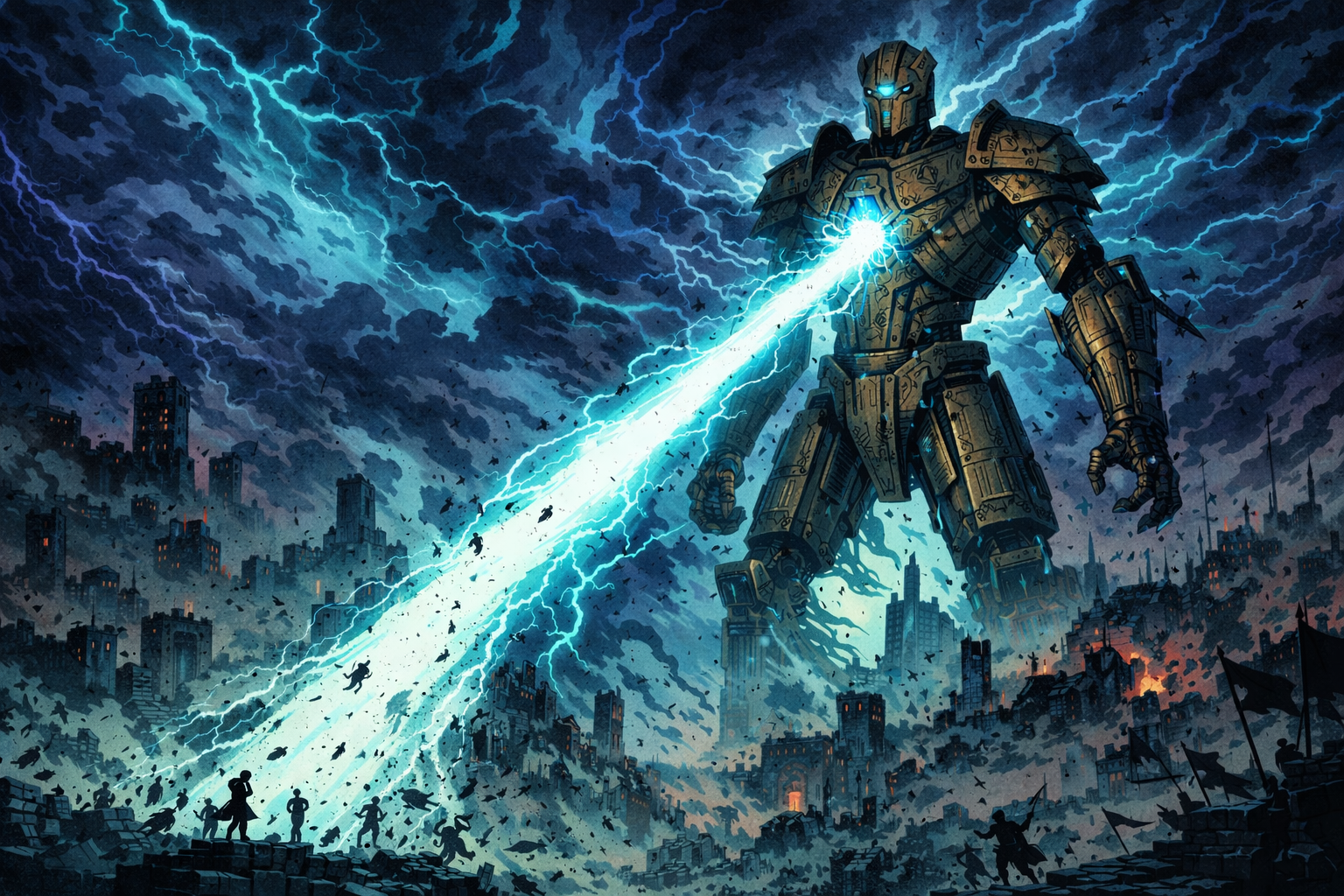
Illustration de la quête 10 — The Rumor of Walk-Brass

Opening

War has a way of making truth feel simple. Steel, banners, mud, the hot stink of breath inside a helmet. In those hours, the party can believe the world is still a thing that can be measured by distance and blood. Then the war stops behaving like war. Not on the battlefield, not where the party can point and say: there, that is the horror. Somewhere else, far enough away to be unbelievable and close enough to be felt, something enormous wakes up.

Word arrives in fragments first, carried by wounded mouths and shaking hands, the kind of stories people tell because not telling them would be worse. A brass shape seen against lightning. A sound like a mountain kneeling. A clean beam of pale fire that turns ranks into ash without heat. And then the strangest detail of all: the way the story keeps changing depending on who tells it, as if reality itself cannot hold still long enough to agree.

If the party has fought the Dominion in the open, they already know how the Thalmor operates. Precision. Timing. Calm voices in chaos. What they do not know yet is how it feels when that precision stops aiming at cities and starts aiming at the rules under cities. Numidium does not need to stride into the campaign as a spectacle. It enters as pressure, a wave that changes how the world talks, remembers, and sleeps. The war continues, yet everyone who matters begins acting as if the war is now only a distraction.

Campaign Note

Read aloud

“You hear it in the way veterans speak when they think nobody important is listening. Not bravado, not fear, something older. The kind of voice people use when they admit the world did something it was not supposed to do. They don’t say it happened here. They say it happened, as if location stopped mattering for a moment.”

The Rumor That Will Not Agree

Three versions of the same impossible event begin circling the party like crows. Each is plausible in the awful way war makes anything plausible. Each is delivered with absolute sincerity, which is what makes it worse.

A courier swears that, far to the south, a coastal watchtower saw a brass giant reflected in black water for the length of a heartbeat before the sea boiled into glass. A deserter claims a whole night vanished on the road, as if the sky blinked and the calendar tore, and he woke with a different sunrise in his mouth. A white-faced scholar whispers one detail that turns rumor into dread: the Thalmor has been asking questions about old sites associated with Numidium’s history, including places tied to its assembly and to the Mantella, the heart-like power that makes the brass move.

The party does not need the truth yet. They only need the consequences. Trade slows because merchants are terrified of roads that might forget they exist. Temples fill because priests prefer a world with gods to a world with broken time. The Dominion grows bolder because confidence is easy when you believe you can rewrite outcomes. And the party realizes, with cold clarity, that if Numidium is truly moving again, the war they can fight is no longer the war that matters.

Ra’zzir : “This one has heard many lies with boots. These are different. These lies sound like the sky is trying to remember which way time goes.”

The Bastion Call

This begins the moment the party stops improvising. They have proof, plans, aetherium, and now a world that is tilting. The only sane move is to return to the bastion they chose earlier, because every other road ends with the party alone in the dark, holding an artifact empires kill for.

Getting there tastes like the first bite of a new kind of hunt. Not soldiers, not bandits. Watchers. Polite questions asked twice. A stranger who turns away a half second too late. A quiet attempt to separate one member of the party from the rest, as if the city itself is trying to see what breaks. If pressed, it becomes a street fight or a clean arrest attempt. If handled carefully, it becomes a lesson. The Dominion does not need to win every battle if it can predict where you will go next.

When the party reaches the bastion, the reception is not gratitude. It is assessment. The tablet comes out. The journal. The aetherium fragment. If the party hesitates, nobody raises a voice. There is only paperwork and silent guards, which is worse. If they comply, the room changes temperature as soon as the words Aethernautic Vessel and Numidium sit side by side on the same table.

The Quiet Part

The bastion’s best mind arrives without theater. Irius Quill looks like someone who has spent too many nights in lamplight and too many mornings pretending sleep is optional. He does not speak like a prophet. He speaks like an artificer trying not to panic.

Numidium is not only a weapon, he says. It is an engine that makes outcomes refuse each other. That is why its history is wrapped in paradox and contradictory testimony. That is why one witness swears the beam burned cold and another swears it burned hot and both are telling the truth as their world allowed it. There is a lore term for it, an old one, spoken carefully by people who remember what the Brass God did to the West. A Dragon Break. Time becomes non-linear. Multiple endings bleed together before snapping back into a single world that carries the scars and none of the explanations.

The conclusion is brutally practical. If Numidium is active again, the party cannot win a fight against it in the normal sense. They need a way to survive proximity. They need an anchor, something that can hold their own choices in place when reality tries to rewrite the page while they are still on it.

Irius Quill : “A sword cannot cut a contradiction. If it walks again, we do not need bravery. We need something that makes the world agree with itself.”

The Lore Anchor

The moons are not scenery in Elder Scrolls cosmology. In Khajiiti legend, the motions of Masser and Secunda form the Lunar Lattice, Ja Kha’jay, a metaphysical pattern that protects Mundus from the Void by keeping the world’s shape from dissolving into hunger. The bastion does not treat this as a bedtime story. It treats it as architecture, the way Dwemer treated gods as problems that could be measured.

Imperial history gives the other half of the argument. There were programs, once, that looked past Nirn with the same ruthless curiosity the Dwemer once used on everything. The Imperial Mananauts. Reman-era ambitions that left dead ledgers and half-erased routes, the kind of documents that survive only because no one believes them. Put together, the bastion reaches a conclusion that makes everyone go quiet. If Numidium is warping the rules, the counter is not bigger swords. The counter is an anchor designed to hold the rules steady.

The Masser Proposition

The bastion does not call it a miracle. It calls it a lead. In old notes and sealed references, a rumor surfaces of a Mananaut reliquary on Masser, a sealed vault with a name that reads like a metaphor and a tool at the same time: the Lattice Keystone. A device or relic designed to attune to the Lunar Lattice, to harmonize with its stabilizing pattern the way a tuner brings a screaming string back to one note.

It is not fully documented, because anything fully documented would have been looted, politicized, or burned. It is a plausible missing piece built on established cosmology, the kind of thing an empire would hide off-world because keeping it on Tamriel would mean every court would eventually fight over it. The party does not need to believe in faith. They only need to believe in precedent. Empires hide what they fear. Scholars hide what they cannot defend. The moons are far enough away to make both kinds of hiding look like safety.

Play Sequence

Beat 1: The First Rumor That Sounds Like Evidence

In a crowded camp, a clerk mistakes the party for someone else and nearly drops a bundle of dispatches. One letter mentions Rimmen and the Halls of Colossus in the same breath as unusual auroral phenomena and Aldmeri operatives requesting quarantine authority. The handwriting is careful. The seal is familiar in the wrong way. The phrase “walk-brass” is spoken by officers who do not joke.

It does not need to be fully accurate. It only needs to be accurate enough to scare the right people. The party leaves with one new certainty: someone is trying to keep the truth contained, which means the truth is real enough to matter.

Beat 2: The Bastion Door

The bastion feels different depending on which seal the party accepted in the Imperial City, but the sensation is the same. Wards like cold glass. Rooms that smell of ink and wet stone. Corridors where every footstep feels judged. Behind it all, the sense that safety is never free, it is rented with conditions and paid for in silence.

If the party once leaned on the Synod, Magister Calara Vorian is present in the room, eyes bright with controlled hunger, already thinking about workshops and protocols and what it will cost to keep the work quiet. If they leaned on the Order of Whispers, Silene Noct watches without looking like she is watching, already thinking about routes that erase footprints and about which witness will become a problem tomorrow. If they leaned on the East, Vedran Relas listens with the patience of House politics and the cruelty of House memory, already deciding what he can offer that will not embarrass him later.

Beat 3: The Logic That Kills Comfort

The term Dragon Break is said aloud, and the room tightens. Not because everyone understands it fully, but because everyone understands what it implies. If time itself can fracture, then bravery is not enough. Skill is not enough. Even faith becomes complicated, because what does prayer mean in a world that might answer with two contradictory outcomes at once.

The party is offered something that feels like sanity: a plan. A lead. A place where the world might still have a seam that can be held. Masser, and whatever remains there of Mananaut ambition.

Beat 4: The Plan That Makes Everyone Go Quiet

Reaching Masser requires the party’s own Aethernautic plans to become real. That means resources. Workshops. Wards. Engineers. Supply lines. It also means control, because institutions cannot help without trying to own what they help build. The Synod speaks of sanctioned labor and safety. The Whispers speaks of false papers and quiet routes and erased witnesses. Redoran speaks of honor-bound silence and Dwemer-hardened pragmatism. The words differ. The meaning is the same. If the party signs, they gain momentum and protection, and they also become, a little, owned by whatever seal they accept.

Beat 5: The Dominion’s Answer

The scenario ends with proof that the party is not racing a rumor, but racing an opponent. A sealed envelope appears where it should not be. No broken lock. No forced window. Just paper, and the quiet humiliation of being reached. Inside is a single line of impeccable Aldmeri, written as if it were a courtesy.

“Your next voyage will be shorter than you hope.”
Agent Vaelor

The bastion reacts the way institutions react when they realize they are late. Doors lock. Orders are given. The party is told, very calmly, that leaving tomorrow is not ambition anymore. It is survival.

Outcomes

The party leaves with a clear axis for the campaign. Masser is not a backdrop. It is the next key location, the place where the counterweight to Numidium might exist. They also leave with a new kind of pressure: not only armies, but scheduling, logistics, spies, and the slow violence of being important.

If they embraced the bastion’s structure, they gain resources and a mission brief, and they accept that someone else will be watching the budget and counting the hours. If they resisted, they keep more freedom, but they must steal what they need, recruit their own specialists, and accept that the bastion may become an uneasy ally instead of a patron.

Ending

Close on the sense of a world preparing to tear again. Soldiers march. Mages argue over wards. Priests pray harder than they admit. Somewhere far away, reality has already learned it can be bent, and once a thing learns that, it rarely forgets. The party stands at the threshold of the campaign’s true genre shift, from war and intrigue into the old Elder Scrolls kind of impossible, where you do not only fight enemies, you fight the consequences of gods, machines, and stories that refuse to stay singular.