← Back to Act III

The Weight of Thrones

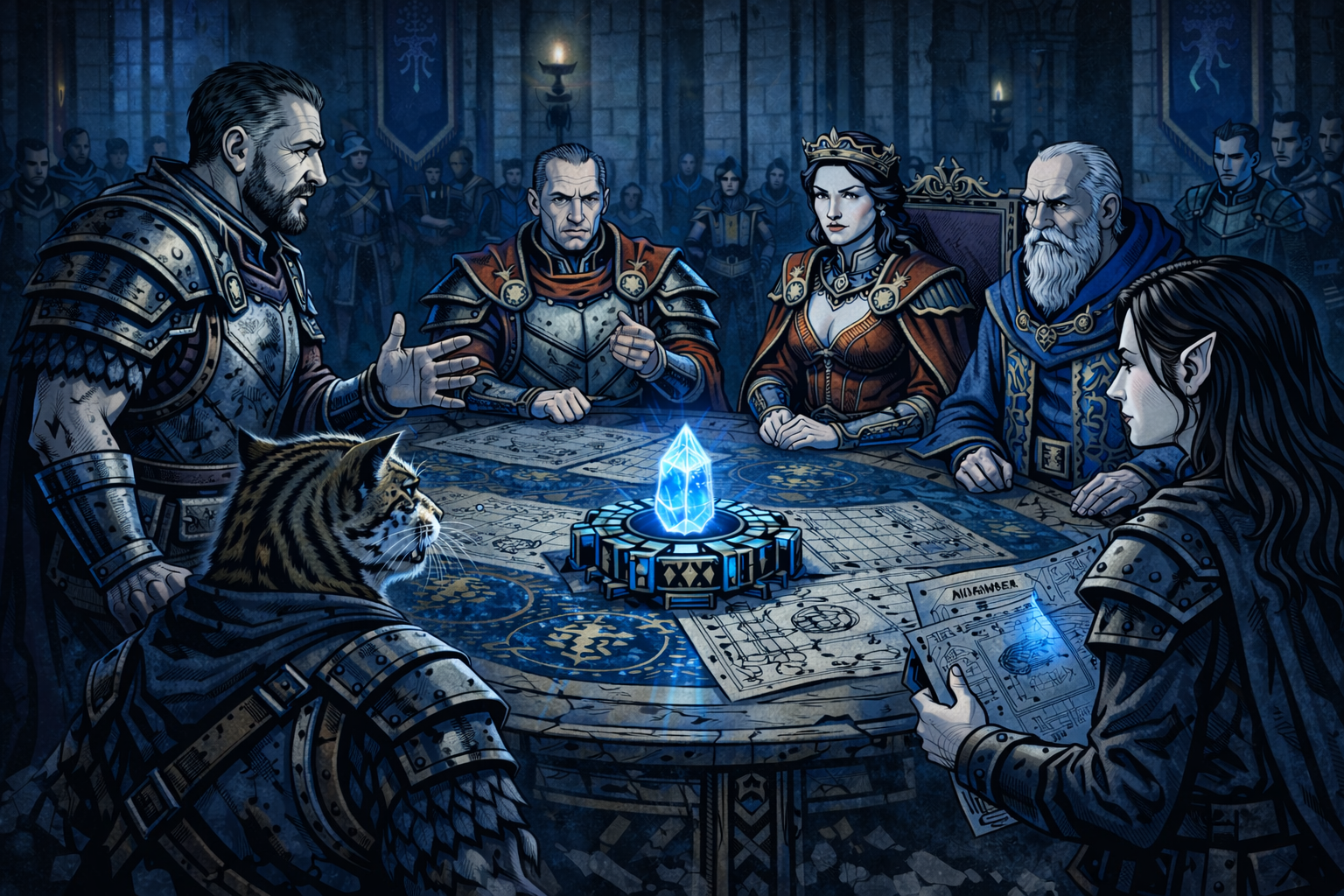
Illustration de la quête 8 — The Weight of Thrones

Opening

The party comes out of the mountains with proof in their hands and a target on their backs. A Dwemer tablet that speaks of an Aethernautic Vessel. Plates of plans that look like engineering, not myth. Aetherium that hums like a held note under skin and cloth, as if the world itself is trying to remember a rule it once knew. A journal that reads like a shipwright’s log written by people who believed the sky was a road.

They crossed the line where knowledge stops being curiosity and becomes leverage. And leverage attracts hands that do not ask permission. It attracts attention with seals. It attracts attention with clean gloves. It attracts attention that can turn a tavern into a trap and a city gate into a mouth that wants their names.

Sooner or later, the same thought lands in the group like a stone: they cannot do this alone. Not against the Dominion’s reach. Not against the slow violence of bureaucracy, where a name can be erased with ink and a person can be made contraband by a clerk’s bored hand. If they want to keep what they found, and if they want to stop whoever is trying to rebuild it, they need allies. Real ones. Institutions. Titles. People with armies, vaults, and rooms where secrets are spoken softly because the walls are paid to listen.

Campaign Note

Read aloud

“You can hide from bandits. You can even hide from mercenaries if you have hills and luck. But you cannot hide from an empire’s attention once it turns toward you. When power notices you, the question stops being whether you will be hunted. The question becomes who will claim you first.”

The Summons

The reason this begins now is simple: the world has started moving around the party without asking them. Their story traveled faster than their boots. Somewhere, a survivor talked with shaking hands and a hungry mouth. Somewhere else, a seal was recognized by a man who lives on ledgers the way fishermen live on tides. A word was repeated too carelessly in the wrong market stall (aetherium), and the world adjusted around it, subtle at first, then inevitable. If the ambush outside the Hollow Brass left them with the taste of steel, it also left them with the lesson behind the steel: that was a first attempt. The next attempt will be cleaner.

The summons arrives wearing manners. A courier finds them in a crowded street and offers a sealed message with the careful respect of someone delivering danger he did not write. A patrol captain “invites” them for questioning and then escorts them, quietly, to a room where their names are already known. Or word comes from someone who has earned a habit of surviving cities, someone like Celinne Fairmont or Salim Jarin : foreign agents are asking questions that sound like commerce and feel like a knife, offering absurd sums for “salvage rights,” speaking about a Dwemer tablet as if it were a crate of spice. Either way, the message is the same. The party is no longer small enough to hide behind luck.

The paper’s weight: “You are instructed to present yourselves for discreet audience regarding matters of state security and unlawful relic traffic. Refusal will be interpreted as hostility.”

The Imperial City

Cyrodiil’s heart does not feel like a place. It feels like a machine that learned to look beautiful. White stone. Banners. Guards who stand still like they are part of the architecture. Canals that carry reflections of towers. Crowds that make every face feel replaceable, and therefore expendable.

Here, they feel watched, not by one person, by the city itself. Everyone is polite, and politeness is a way of measuring. Servants listen. Clerks remember. Guards see more than they admit. When the party shows a seal, doors open. When they show hesitation, doors open more slowly, as if deciding whether they are important enough to be dangerous.

The streets are loud with commerce, but the city’s real decisions happen behind quiet doors where voices stay low and ink stays wet. Somewhere above the noise, in chambers that smell of parchment and old stone, the Empire turns people into categories. Witness. Asset. Liability. Contraband. Enemy. The party has walked into a place where words are weighed, and the scales belong to someone else.

The City’s Terms

The Imperial City does not threaten with raised voices. It threatens with offers that sound reasonable until you realize what they imply. It offers protection that comes with recordkeeping. It offers access that comes with witnesses. It offers a safehouse whose guards are both shield and leash, and it offers papers that open gates while also telling every gate who you are and where you went. In the mountains, danger came as steel. Here, danger comes as courtesy. Courtesy is harder to refuse because refusing it makes you rude, and rudeness is the first excuse bureaucrats use when they decide you are a problem.

The party must learn a new kind of survival. In halls like these, the wrong sentence becomes a precedent. A name spoken too loudly becomes a file. A casual boast becomes a summons. Even allies apply pressure, because every ally is also a faction with its own hunger. Support is real. So are obligations. The question is not whether the party will be bound, only whether they choose the knot or let someone else tie it for them.

“Power is generous the way a blade is sharp. It will help you cut what you point it at. It will also cut you if you forget which end you’re holding.”

Play Sequence

Beat 1: Arrival with Heat

The party arrives in Cyrodiil and learns immediately that their story traveled faster than they did. A guard captain knows too much. A clerk pauses when reading their names, as if comparing them to a list that was never meant to be public. Across a plaza, a stranger in fine gloves watches them for the length of one breath and then leaves without haste, as if the city itself has already decided what they are.

There is a small window, right there, between the city noticing them and the city deciding what to do with them. Some walk straight into the light and present themselves as witnesses with evidence, trusting that honesty will be rewarded with stability. Others seek shadows first: a back-room meeting, a locked chest, a cache under a floorboard, the quiet comfort of knowing not all proof can be seized in one polite motion. Whatever choice they make, it stains the rest of the day. In the Imperial City, choices do not vanish. They become paperwork.

Beat 2: The First Gatekeeper

Power does not meet strangers at the threshold. It meets them through people trained to decide what a stranger costs. Caeso Vibius does not look like a jailer, but the antechamber has the same function as a cell: it holds you until someone decides what you are. He asks practical questions with careful hands. Where did you find it. Who else knows. Who followed you. What proof can you show without turning the palace into a spectacle. Every answer becomes a weight placed on an invisible scale.

If the party reveals the tablet or the fragment, the reaction is not disbelief. It is restraint. A pause, the kind that feels like a door closing softly somewhere behind you.

Caeso Vibius : “If what you claim is real, you have not brought us a relic. You have brought us a war schedule.”

Beat 3: Audience in a Room Built for Power

The party is brought into a chamber that feels older than anyone in it. The kind of room that tells you, without words, that the building expects obedience. On one side, Legate Serena Aquilios, polished restraint, military patience. On another, Councilor Vicentius Daro, ink-stained fingers and a smile that learned to appear without warmth.

The party does not need to perform. They only need to place the truth on the table and watch the air change. The tablet speaks, even when no one reads it aloud. The plans look too precise to be superstition. The journal reads like logistics. When the phrase Aethernautic Vessel lands in the room, it lands like a stone in still water, and every ripple is a new question: how close is the Dominion, who else knows, how quickly can this become a weapon, how quickly can it become a disaster. When they mention Thalmor interest and the mercenary ambush, the audience stops being curiosity. It becomes a timetable.

Beat 4: The First Alliance Offer

The Empire’s offer is never purely altruistic. It will sound like protection, and it will be protection, but it will come with a frame: oversight, secrecy, and the demand that this becomes a state matter. Papers that open gates. A safehouse with guards who smile too little. Access to restricted archives. In exchange: regular reports, silence, and a clause that grants the right to take custody “if necessary,” which is how empires say “if you become inconvenient.”

Support reduces danger, but increases obligations. Refusal does not turn the Empire into an enemy overnight, but it changes the temperature of the room. Suspicion is a slow poison, and in courts it always smells like courtesy.

Beat 5: The Second Door, the Arcane Door

Arcane authority does not stay out of a room like this for long. The Synod arrives with polished language and protocols that sound like safety. The Order of Whispers arrives with quiet smiles and the promise that secrets survive best when they do not sit still.

Magister Calara Vorian speaks like a scholar and listens like a predator. She offers laboratories, funding, formal support, and the promise of “responsible study,” which is another way of saying she wants to be the one who writes the rules. Silene Noct offers secrecy, intelligence, and the promise of striking first. Both want the plans. Both want the tablet. Both will insist on protocols. Both will ask for a demonstration: controlled, measured, contained, because everyone in that city is afraid of anything they cannot put in a box.

“Aetherium does not behave like magicka. If the Dwemer wrote routes, then they believed the Void has currents. That is either genius or blasphemy. Either way, it is usable.”

Beat 6: The Third Door, the Eastern Door

And then there is the East, arriving the way the East always arrives in Cyrodiil: through emissaries, through courtesy, through politics wearing silk. Vedran Relas speaks of Dwemer knowledge as if it were heritage. He listens to it as if it were a weapon. In Morrowind, Dwemer technology is a nerve. Whoever claims insight into it gains prestige, bargaining power, and the ability to embarrass rivals with truth sharpened into a knife.

Vedran offers a different kind of support: artifacts, scholars who grew up around Dwemer bones, smugglers who can move things quietly, and political cover in eastern territories. The cost here is not contracts. The cost is entanglement. House politics do not let go once they hold something valuable.

Vedran Relas : “My House does not fear Dwemer ghosts. We have lived with their bones for centuries. Give me a copy of the journal, and I give you people who know how to walk Dwemer halls without dying.”

Beat 7: The Build Question

Eventually, someone says the sentence that has been hiding under every polite question. If the Dominion is trying to reproduce this, the party cannot simply hide it. Hiding is losing slowly. The counter move is audacious and terrifyingly practical: begin reconstruction. Not in the open. Discreetly. In a sealed laboratory, a remote shipyard, a repurposed Dwemer hall, or a hidden annex with guards who do not wear their true uniforms.

The room does not agree easily, because agreement here is not an opinion, it is a liability. A secret project needs political cover, supply chains, skilled hands, and silence. Silence is expensive. Silence also breeds its own enemies: rivals who resent being excluded, officials who fear being blamed, and opportunists who can smell a budget diverted into the dark.

When the offer comes, it comes with teeth. A patron will promise cover and resources, but only if the party delivers one more necessary piece: a second source of aetherium, a living Dwemer specialist, a secure build site, or a missing component named in the journal. The terms feel practical, almost fair. That is what makes them dangerous. Practical deals are the ones that bind.
Outcomes

They leave the Imperial City with real support and a clear next step. Travel papers that make gates obey. Coin that buys silence. A safehouse that feels secure until you realize it is also a place someone can find you. A political letter that opens doors and writes your name into other people’s memories. Access to an arcane translator who will speak of “procedure” the way priests speak of sin. And, if the party’s words held steady, the promise of a sealed build site in exchange for one final key piece.

They also leave with a new kind of danger. A handler assigned to “assist.” A rival patron who smiles too much. A whisper that someone in the court is compromised. And, somewhere in the city’s moving machinery, a report drafted with careful words that proves the Dominion is not guessing anymore. It is watching.

“You came here to find allies and you did. Now you also have witnesses, patrons, rivals, and obligations. That is what power gives you. It is a shield that becomes a collar if you forget who fastened it.”

Ending

Close on a decision that feels like a door locking behind them. The party chooses who they trust most, or chooses to balance factions carefully, and they leave the Imperial City with a package of authority that makes them safer and more visible at the same time.

Somewhere, ink dries on a document that reroutes resources quietly. Somewhere else, a gloved hand reads a report and smiles, because the game has become official.

Optional sting: A wax-sealed envelope, left in their room before they even rent it. Inside, a single sentence in impeccable Aldmeri: “We saw you enter.”
Agent Vaelor