← Back to Act IV

Ash Under a Blue World

Illustration de la quête 13 — Ash Under a Blue World

Opening

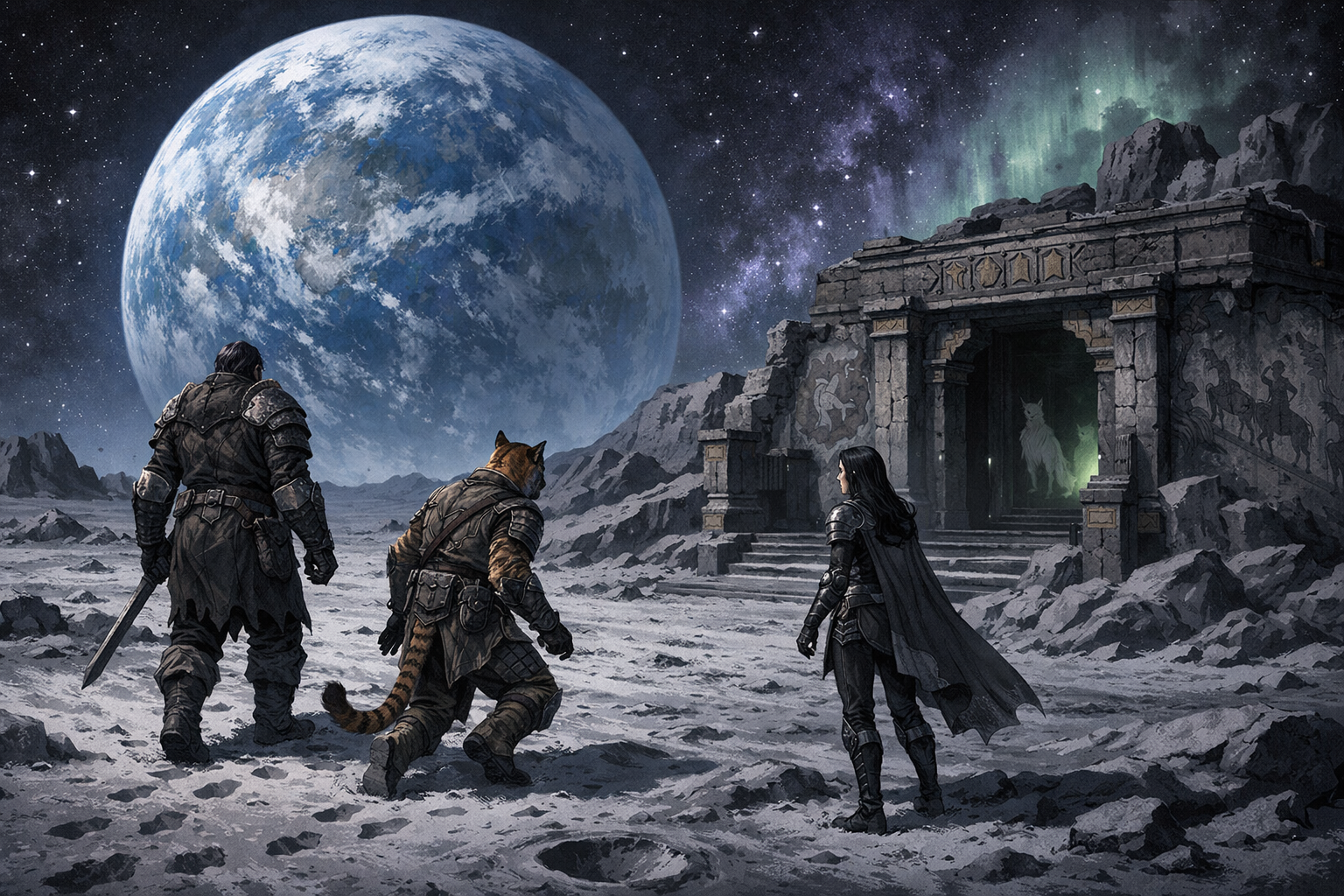
The first step onto Masser is not heroic. It is careful. The ramp lowers with a metallic sigh that feels too loud in a place that should not care about sound, and the party puts boots into ashen dust that does not behave like Tamriel’s earth. It shifts like powder, then settles like old smoke. Above them, the sky is wrong in the simplest possible way, too clear, too hard, too empty of familiar weather. And on the horizon, impossibly present, Nirn hangs as a gigantic bluish sphere, streaked with cloud like a living bruise, so close it makes the chest tighten. It is beautiful, and it is a reminder. Home is not a direction anymore. It is a body in the sky.

The Hope of Cyrodiil sits behind them like a heresy that has survived its first test. Its wards hum low, its brass skin dull under alien light. The crew is silent in the way people go silent when the world has changed categories. The party feels it too. They are not exploring a mountain. They are trespassing into a place the world has tried to forget, and the reward for being first is that nothing here is built for them.

The ship did not come alone. The three factions that agreed to share a heresy are still here, if the Void did not collect them first. Calara Vorian stands in the Synod’s posture, discipline made human. Silene Noct moves like the Whispers, checking angles the way other people check prayers. Vedran Relas, if he came, looks at Nirn hanging there and does not blink, because soldiers learn to stare at things they cannot fix.

And then there are the two variables the party may already have paid for. If Irius Quill survived the bastion, he stays close to the wards and the aetherium’s note, listening for the hitchhiker sound the Void promised, because he knows the ship’s protections are as much language as they are light. If he did not, Calara’s protocols and Silene’s instincts have to substitute for a mind that used to hold the whole plan at once. Helvion Sarn is here if the crossing did not take him, hands and tools and stubbornness, the kind of person who can make a correction true when everyone else can only describe it.

If the Void left anything behind, it will not announce itself. A faint scorch in the shape of a glyph under one rivet. A cold patch on the hull that will not warm. A seam that makes the aetherium hum change pitch for the length of a heartbeat. The ship made it. The ship might still be followed.

Campaign Note

Campaign Note

Read aloud

“You step onto dust that has never known rain. You look up and see Nirn hanging there like a lantern too big to hold. The thought arrives with no mercy: if you fall, you do not fall onto ground. You fall into a story that may not let you back out.”

This is the first act of extraterrestrial play. Keep it tactile and strange. Let awe arrive, then charge interest on it immediately. Masser should feel like a location with rules, not a painted backdrop.

The Moon

Masser’s surface is sterile in the way a tomb is sterile. Craters carve the landscape into bowls and scars. Fine gray dust coats everything, clinging to boots and seams. Light falls without kindness, sharp and cold. Gravity is light enough that every movement feels off, as if the body is overpowered for the world it’s in. Jumps go higher. Falls take longer. Momentum becomes a quiet hazard. A stumble can become a drifting slide, and a careless leap can turn into a slow arc with no way to correct midair.

The horizon is close. The sky is too big. The silence has weight. Even if the ship’s wards provide air and warmth, the party should feel like they are walking inside a bubble of stolen comfort, surrounded by a place that does not want them.

The Hidden Structure

The entrance is not dramatic at first. It is a contradiction in the dust. Lines too straight to be natural. A patch of ground where ash settles differently, as if stone beneath has a different temperature. A faint hum that only becomes noticeable when someone stops moving. The plans and notes point to the same region, a crater rim with a subtle scar that looks like a seam.

Under the surface lies an ancient complex, an observatory or temple built by Merethic mages, or an older structure whose purpose is the same, watching the sky like it is scripture. Corridors glow with luminescence that has no flame source, a pale light that makes faces look carved. Inscriptions run along walls in languages that feel familiar in rhythm but refuse to be read. Doors answer alignment rather than strength. And deeper in, the place begins to suggest it was not abandoned so much as deliberately left alone.

How to Run It

Treat the surface approach as a threshold and the structure as a classic dungeon, but with lunar physics and alien ambience shaping every choice. Low gravity makes combat and traps feel different. Movement is slower on falls, faster on leaps, and harder to stop. Use checks to make this real without turning it into math. Let athletic control, balance, attention, and wardwork be the quiet engines that keep the party alive.

The dungeon should feel like three layers of mystery. First, the physical environment and its hazards. Second, the inscriptions and mechanisms that hint at purpose. Third, the traces of someone else having lived here, briefly and desperately, long ago. Make those traces personal enough to matter.

Play Sequence

Beat 1: First Footfall

The party disembarks, and immediately the world tests them. A simple step turns into a longer stride than expected. A thrown pebble arcs too slowly. Dust clings in ways it should not. Give them a short moment of exploration, then demand a controlled action that makes low gravity real. Crossing a shallow crater lip without sliding. Leaping a fissure that looks small but is deeper than it seems. Securing a line back to the ship in case dust rises, or something stranger forces retreat. One early check sets the tone. Success means confidence. Failure means a minor injury, lost equipment, or a slow tumble that is more frightening than painful.

If Vedran is with them, this is his scene to be mortal. The dust does not behave, the traction lies, and a simple misstep becomes a long, humiliating drift toward a crater edge. If the party keeps a line on him, catches him, anchors him, he lives, shaken and furious at himself, and his later words about sacrifice carry the weight of someone who almost became a footnote. If they do not, the moon takes him the way the moon takes everything, quietly, slowly, with enough time to understand what is happening and not enough time to change it. The expedition continues either way. It simply continues with one less voice insisting honor still matters.

Beat 2: The Blue World on the Horizon

Give them the view when they least expect it. They turn, and Nirn fills half the sky, and for a second everyone is quiet. Let this be the emotional anchor. Encourage a player to name a place they can see in imagination, to remember a person they left behind. Then cut the softness with something practical. A faint signal from the ship’s instruments. A shimmer in the dust. A shape that is not a rock because it casts a shadow too straight.

Beat 3: Finding the Seam

The entrance is discovered through attention, not luck. A line in the ash that does not belong, a shallow groove running too perfectly along stone. A patch where dust refuses to settle, as if repelled by a ward still working after ages. If the party has the Dwemer plans, they recognize a marker. If they have guidance, they feel it as pressure in the chest, a silent insistence. Either way, the entrance should require a small act to reveal. Brushing dust away in a pattern. Setting aetherium near a concealed node to make the seam glow. Echoing a word from an inscription that cannot be read but can be answered.

When it opens, it opens like a wound, not with violence but with inevitability. Stone shifts. A breath of cold that is not air rolls out, and the glow inside paints the dust at their feet pale.

Beat 4: The First Corridor

Inside, the rules change again. Light is constant and sourceless. Walls are smooth, too smooth, carved by magic or methods that made stone behave like wax. Sound feels dampened. Footsteps soften. The corridor slopes subtly downward, and the slope matters because low gravity turns any incline into a slow drift if you stop paying attention.

Introduce the first environmental puzzle. A section of corridor is segmented by deliberate gaps that require controlled leaps. Each gap is easy if you respect momentum. Each is dangerous if you rush. This is where choice matters more than dice. Take time. Anchor a rope. Use magic to stabilize a landing. Or gamble on speed and hope the floor forgives you.

Beat 5: The Observatory Hall

The complex opens into a chamber that feels like purpose. A circular hall with a domed ceiling and a central instrument, a brass and stone apparatus that points nowhere and everywhere. Its arms are frozen mid-adjustment, as if someone left in the middle of taking a measurement. The walls bear inscriptions in spirals and bands, and the party can tell the language is old, pre-Imperial in mood, but not Dwemer. Lost Merethic script, perhaps, or something older. Reward attempts to read it with partial meaning, not full translation. Words like “lattice,” “breach,” “anchor,” “song,” returning like a prayer that became engineering.

This place was built to watch the boundaries, to observe how stars behave as breaches, to chart something that looks like safe passage. It suggests the moons are not just rocks. They are part of a system. It also suggests the system has opinions about who is allowed to touch it.

Beat 6: Traces of a Brief Colony

Deeper in, the tone shifts. The architecture remains ancient, but the signs are not grand. They are personal. Scratches on stone where a small hand marked time. A woven strip of cloth preserved in a sealed niche. A crude map etched over a perfect inscription, someone trying to make the place legible in panic.

Then the party finds the frescoes. Caravans climbing toward the sky. Khajiit silhouettes under a moon drawn like a crown. Figures standing around a pillar that reaches upward, hands raised as if in worship or calibration. It implies someone tried to live here briefly, maybe as pilgrimage, maybe as experiment, maybe as exile. And it implies they failed.

If you want a haunting, give them the ghost. Not a screaming specter, but a quiet presence at the edge of the light, translucent fur and tired eyes, speaking as if continuing a conversation started centuries ago. It does not know the modern Empire. It knows hunger and fear and the strange kindness of low gravity that made falling slow enough to pray during it. It can tell them one crucial thing. The pillar exists. It was used. It did something. And when it did, the sky answered.

“We came because the moons promised a path. We stayed because the path did not open. We died because the door chose silence.”

Beat 7: The Locked Descent

End this chapter by pointing them toward the deeper mechanism. A sealed door beneath the observatory hall, covered in concentric rings of script that resemble both lock and calendar. It answers alignment, phases, resonance. The party can feel that the pylon, the pillar, whatever can affect Numidium from afar, is not in the first rooms. It is below.

The door is not only physical. It is ideological. It was built to keep the wrong hands out. Give the party a final choice that sets the next scenario. Force it now, risking damage to wards or triggering ancient defenses. Or withdraw to the ship to regroup, translate, and plan, knowing time is not an ally and that something else may have noticed their footprint on the moon.
Outcomes

By the end of this scenario, the party has made Masser real as a place with rules and hazards. They have located the ancient structure and entered it, confirming that pylons and lattice theories were not delusion. They have found evidence that someone tried this before, leaving traces that turn the moon from sterile rock into a grave of ambition. If they met the Khajiit ghost, they also carry a story that makes the stakes intimate rather than abstract, proof that the moon has already judged mortal hope once.

If a companion died on the surface, it changes the tone of every corridor below. If they saved that companion, it changes who carries the fear. Either way, the party now understands the moon does not care about intention, only about whether you learned its rules fast enough.

Ending

Close on the sealed descent door, inscriptions reflecting off dust-coated armor, and Nirn visible through a distant corridor opening like a reminder that the world is still there, still fighting, still burning. The party stands on extraterrestrial stone with the weight of a whole war behind them and a mechanism ahead built to be used only when the sky becomes an enemy.

Cliffhanger: the rings shift a fraction, answering the aetherium’s hum, as if the moon has finally decided to listen.