← Back to Act IV

Resolution: Activation or Failure

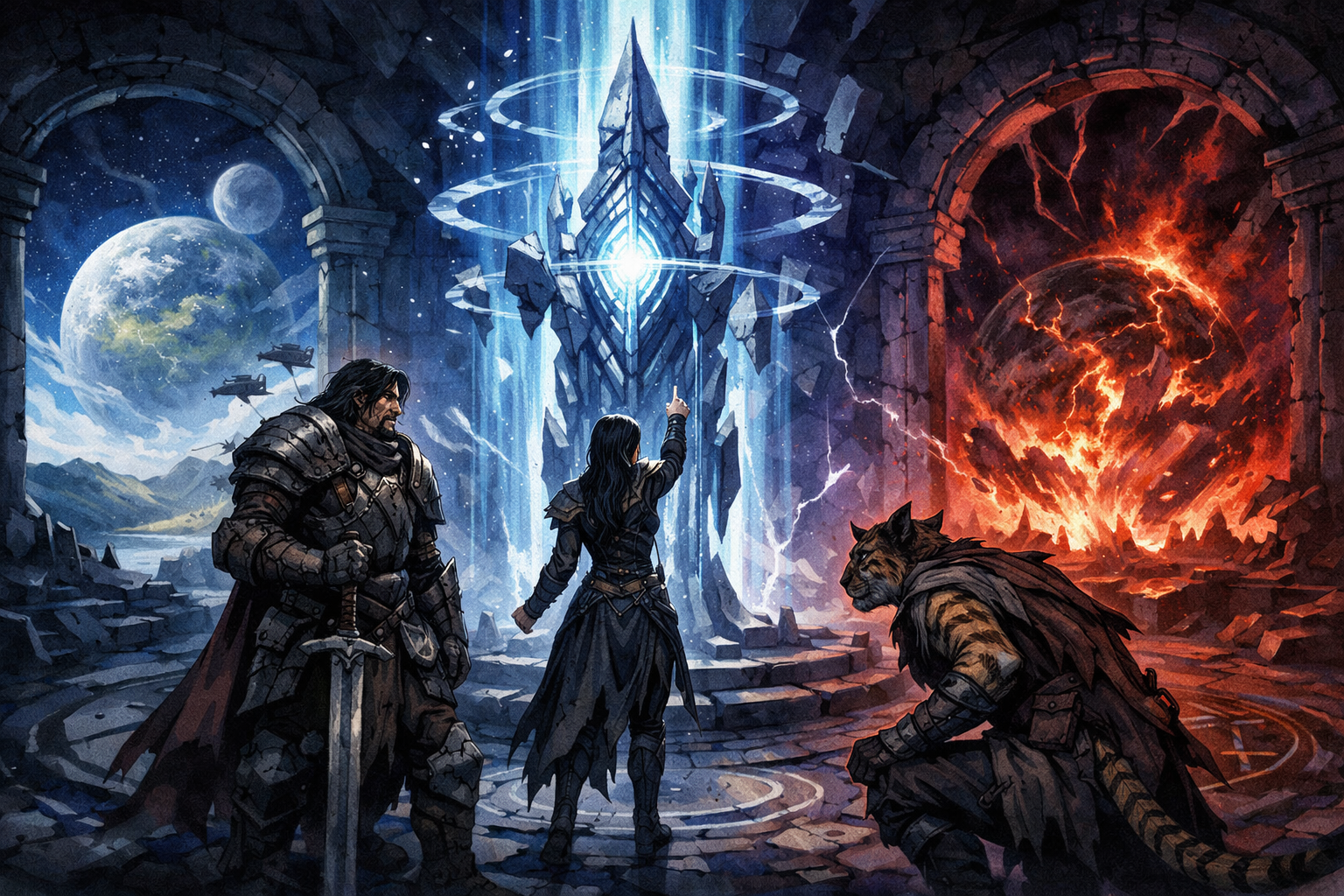
Illustration de la quête 15 — Resolution: Activation or Failure

Opening

Once the boss falls, the room does not become peaceful. It becomes louder in a different way, like silence with teeth. The Aetherius Pylon stands at the center of the chamber, still humming, still threaded to the star breaches above, still throwing pale rays across inscriptions that look like math written by people who believed the sky could be negotiated. The party is bruised and out of breath, and for the first time in a long time nobody is actively trying to kill them in the next ten seconds, which is when the real weight finally arrives. They did not come here to win a duel. They came here to touch a mechanism that can decide whether Nirn keeps existing in a recognizable shape.

The pylon does not feel like a lever. It feels like a choice that was never meant to belong to mortals. Its light responds to proximity like a living thing. The aetherium fragment hums in sympathy, as if it recognizes an old language. Down in the far distance, through layers of stone and distance and war, the party can almost imagine the brass titan moving, bending the world as if the world were thin cloth. The window to act is open. It will not stay open.

If they are not alone, it is because the campaign has been building toward this room for a long time, and every earlier rescue has a chance to pay dividends now. If Irius Quill is still alive, he keeps one hand on the ship’s ward readings like a man holding a wounded animal still, because he is the one who supervised the build and knows what the ship sounds like when it is lying. If he is not, the deck above feels emptier, and the ship’s hum has to speak for itself. Helvion Sarn, if he still lives, is the person who makes that hum honest with hands and tools, not leadership. If Calara Vorian is present, she listens to the pylon’s note and translates it into orders without letting her voice tremble. If she is not, the party feels the absence of a mind that could turn panic into procedure.

If Silene Noct survived the edges and the portals, she watches the chamber like a knife watching a throat, because the Dominion’s favorite moment is the one after you think you won. If she did not, the edges feel unguarded. And if Vedran Relas made it off the surface, his presence is a reminder that any world saved will be argued over the next morning. If he did not, the arguments still happen. They simply happen without the one voice the party trusted to say them honestly.

Campaign Note

Campaign Note

Read aloud

“There is a moment in every legend where the hero expects a reward and instead finds a decision. The kind of decision that turns victory into responsibility. The kind that tells you, very clearly, that survival and salvation are not always the same thing.”

Irius Quill : “When mortals touch an interface like this, the device does not ask if you are worthy. It asks if you are consistent.”

The Pylon’s Two Uses

Give the players the information cleanly, then let them argue, because this is not a puzzle. It is a moral fork with cosmic consequences. The pylon can be used in two distinct modes, and both work. The question is what “work” means.

Campaign Note

Campaign Note

Do not make the outcomes legible like a menu. The party is not operating a familiar machine. They are touching an interface built for a different scale of mind. They can infer directions, they can feel intent, and they can see that one path is severance and one path is binding, but they should not know the exact shape of the bill until the bill arrives.

Destruction, to them, can plausibly mean destroying Numidium. They do not automatically know it also means striking Mundus like a bell. Reconfiguration can plausibly mean saving Nirn cleanly. They do not automatically know it also means turning the moons into a permanent wound-system. Let their choice be about values under uncertainty, not about picking the option with the best written warning label.

The first mode is destruction. The party can overload and shatter the pylon, turning its lattice into a single catastrophic discharge. That wave will slam through the Mundus lattice and force Numidium into immediate shutdown, like cutting the throat of a god machine with a burst of pure denial. It is fast. It is final. It is also violent in a way that does not care who is standing on the floor when physics hiccups. The risk is not “some damage.” The risk is that the laws of Mundus convulse, that coastlines rewrite, that storms become permanent, that cities fall into the sea, that the world survives but not in the shape anyone recognizes. It is a near Landfall path, an act of salvation that looks suspiciously like catastrophe wearing a heroic name.

The second mode is reconfiguration. The party can tune the pylon, redirecting and binding Numidium’s output into a new sink, pushing the titan’s reality bending away from Nirn and into the lunar system itself. This saves the world below with far less immediate collateral, but it transforms Masser, and possibly Secunda, into something else. A land that glows under cosmic strain, a place where the sky behaves like a wound, where magic is louder, where certain things can survive that should not, and where the pylon becomes a permanent beacon. Nirn is saved, but the moons become dangerous, sacred, and contested in a way that will never stop mattering.

Make it clear this is not a good ending and bad ending slider. This is what the party is willing to pay, and who they are willing to make pay with them.

Silene Noct : “A clean victory is the first lie an empire tells itself.”

How to Run It

Treat the resolution as a final sequence under time pressure, even after the fight. The pylon is active, the chamber is unstable, and the enemy’s defeat does not freeze the war below. Give the party a short window, measured in beats rather than minutes, and let every check represent action in a moment where hesitation has a cost.

You can frame activation as a three step process, whichever mode they choose. Identify the correct console pattern, seat the aetherium key, and maintain the mental anchor while the pylon completes its cycle. Each step can be carried by different characters, and each failure does not stop the attempt. It introduces a complication, a surge, a backlash, a crack in the fragment, a memory scar, or an enemy reinforcement arriving late.

If you want a final sting, let the boss’s remnants still matter. A dying curse. A last ward collapse. A daedric parasite on the hull that begins chewing through the ship’s protection. Not to steal the scene, only to keep the choice sharp.

Keep the supporting cast useful rather than loud. Calara can call out which inscription band corresponds to severance versus binding. Irius can warn when the ship’s wards are about to brown out. Silene can spot the telltale shimmer of a late portal before it becomes a problem. Iriuscan name the lunar phase symbols and keep the party from guessing wrong. Vedran, if present, can frame the political cost without turning it into a debate club, because honor is still a weapon when the room is trying to turn choice into panic.

Give the party a living stake to protect. By this point, one of the surviving allies should feel like the last thread connecting the campaign’s human scale to its cosmic scale. If Iriusis the last one standing, he can offer to take the backlash into his own body so the ship stays coherent, because he understands that a machine can survive a wound better than a world can survive a lie. If Calara is the last one standing, she can offer to become the mental anchor so the pattern holds. If Silene is the last one standing, she can offer to seal the chamber behind them and accept that she might not be on the same side of the door when it closes. Let the party save that person if they choose to pay with something else. Let them lose that person if they choose speed, certainty, or pride. Either way, make the ending remember a name.

Play Sequence

Beat 1: The Room Settles

Immediate danger is gone, but the room is still alive with energy. Rays shift. Inscriptions flare. The pylon’s hum deepens like a heart learning a new rhythm. Give the party a brief chance to take stock, then force the decision by showing the cost of delay. A tremor in the stone. A vision through a breach, a flash of Numidium’s light cutting through a regiment. A sense the titan is not waiting for them to be ready.

Beat 2: The Choice Becomes Clear

Present the two modes as something the party can learn through observation and partial translation. One set of inscriptions describes collapse and severance, the language of finality. Another describes redirection and binding, the language of containment. The aetherium fragment behaves differently near different consoles, humming sharply near the overload cradle, steadying near the alignment cradle. Let a character with arcane knowledge recognize the pattern. Let a character with intuition feel what the room wants. Then let the table decide what they do with that knowledge.

Beat 3: The Activation Begins

Once they commit, make the act physical. Consoles must be aligned. Rings must be turned. Aetherium must be seated. In low gravity, every movement is exaggerated, and every slip is humiliating and dangerous. If they chose destruction, the pylon’s light becomes harsher and more unstable, as if the device resists being forced into suicide. If they chose reconfiguration, the light becomes more structured, rays locking into geometry like a machine remembering its purpose.

Require a mental anchor. Ask for discipline as the stars press close through the breach network. Failure is not instant doom. It is the moment cosmic dread floods someone’s throat, and another character must grab them, speak their name, pull them back to themselves.

Beat 4: The Last Complication

As the pylon reaches its final cycle, introduce a complication that tests commitment. The fragment begins to crack under strain unless stabilized. The ship’s wards flare and dim, suggesting there may be no return path if they push too hard. A portal flickers at the chamber edge, hinting the Dominion sent a last emissary, or the titan’s essence is trying to interfere.

This beat is where the party pays with resources, sacrifices gear, spends rare components, or accepts a permanent mark. Someone takes backlash to protect the others. Someone burns their last healing to keep the anchor steady. Make it feel like the end of a long road, not a button press.

Beat 5: The World Feels It

When the pylon completes, describe the effect as a ripple the party can sense even here. The pylon’s note becomes a clean tone, and breach light stabilizes or flares toward breaking, depending on their choice. For an instant, the moon complex feels like the center of the universe, because for this story it is.

Then, far away, the brass titan reacts. Not with dialogue, not with personality, with physics. A shift. A stutter. A massive absence where certainty used to be.

Heroic Success: Nirn Saved

If the party reconfigures the pylon successfully, the war below ends abruptly in the way wars end when a god machine stops obeying. Numidium falters, its reality bending losing coherence, and the Dominion’s confidence collapses with it. The colossus does not need to explode. It only needs to become inert, or unstable enough that it cannot be used as a clean weapon. Imperial lines hold. Thalmor plans fracture. The sky stops being a battlefield and becomes sky again.

The return can be a triumph, but make it a complicated triumph. They come back aboard the Hope of Cyrodiil if it survives, or by a temporary corridor created by the pylon that feels like walking through a star’s shadow. On Nirn, ceremonies are offered. Titles are suggested. Bards start writing songs before blood is washed off stones. The Empire calls them saviors, because empires need names for miracles. Their bastion, Synod, Whispers, or Redoran will want custody, copies, protocols, secrecy, and rights.

The moment they step back into a room with air that tastes like home, the old world tries to put handles on what happened. Legate Serena Aquilios wants the story to become an order of battle. Caeso Vibius wants the paperwork to become a cage that keeps the wrong hands from the right secrets. Calara wants protocols. Silene wants silence. Vedran wants assurances that the Empire’s salvation does not become Morrowind’s next problem.

The epilogue is where the party decides what they do with knowledge. Hand the technology to an empire that will weaponize it. Destroy what they can, knowing destruction has a cost. Keep it hidden, becoming caretakers of a secret that will never let them live quietly again. And if they diverted energy toward the moons, Masser is changed. Not ruined, changed. A sacred danger that will draw pilgrims, scholars, thieves, and Thalmor survivors like moths to a wound.

Landfall: Nirn in Ruins

If the party chooses destruction, or if they fail to stabilize reconfiguration in time, the pylon’s discharge becomes a catastrophe with a heroic face. Numidium shuts down, yes, but the wave hits Mundus like a hammer to a bell. The laws of the world shudder. Coasts rearrange. Storm fronts become permanent scars. Cities crumble as if their stone forgot it was allowed to be stone. From the moon, the party sees Nirn ignite in streaks, not fully annihilated necessarily, but ravaged into an age that will not be recognizable to anyone who lived before this night.

The party survives, but not comfortably. They are stranded on Masser or in the lunar system with whatever resources they carried, plus any other refugees who managed to flee by vessel, portal, or miracle. The campaign does not end. It changes genre. It becomes survival and exile, building shelter under alien light, rationing air and warmth, dealing with internal conflict between cultures forced into one fragile colony. The moon complex becomes sanctuary and threat, because deep beneath its halls may lurk unknown creatures, daedric remnants drawn to the pylon’s wound, or evidence the lunar surface was never as empty as everyone assumed.

This sequel path gives you a long frame. Founding a colony. Exploring caverns. Defending against raiders. Managing scarce aetherium. Deciding whether to attempt a return to Nirn, not next week, but generations later, when the world has cooled into a new shape.

Even here, the familiar names can still matter. Irius becomes the person who keeps air and heat honest if he lives, because supervision turns into survival fast when you have no sky. Helvion, if he is alive, becomes the hands that follow that discipline and keep the colony from dying to small mechanical lies. Silenebecomes the knife that keeps the desperate from turning into tyrants. Vedran becomes the hand that insists a community can still have honor even when it has no sky.

Conclusion

Whatever happens, the story earns its place. The party crossed every tone The Elder Scrolls can hold. Conspiracy and prison. Flight and pursuit. Ancient ruins and political rooms where courtesy is a blade. War at scale. A voyage beyond the sky. A lunar dungeon where the stars are not distant and gods are not abstract. The campaign’s themes converge here, Empire and Dominion rivalry, Dwemer remnants, the danger of ambition that thinks it can own the laws of reality, and the question behind Elder Scrolls myth, whether mortals can defy the impossible without becoming monstrous in the process.

Close with an image matching the ending chosen. If Nirn is saved, show the world hanging in the sky, still blue, still alive, and the pylon’s light settling into a quieter glow, as if accepting its new role. If Landfall happens, show the same world burning in slow, distant silence, and let the party hear, through the pylon’s hum, the thin line between salvation and ruin. Either way, leave a door. Once you have walked on a moon, there is no such thing as a small horizon.

“The world is still there. The question is whether it will still be the world you meant to save.”

Epilogue: The Age of the Void

Whatever the party chooses, the old world cannot go back to pretending the sky is only a ceiling. They have stood under a star breach and watched it behave like a door, the way the old cosmologies always claimed it did, with Oblivion as the dark in between and Aetherius as the impossible light beyond. They have proven, with blood and aetherium and stubborn hands, that the moons are reachable, not as metaphors, but as places with weight and stone and history, the same moons some texts describe as dead, decaying attendants of the mortal plane.

That single fact is enough to wake sleeping programs and buried ambitions: the Empire remembers the old Mananauts and their void expeditions, Alinor remembers the Sun Birds and the hunger to pierce the veil, and every court that hears the story realizes the next war might not be fought only on roads and seas. Even if Nirn is saved, people will still flee toward new frontiers, scholars will still chase forbidden routes, and factions will still build bastions above the world, because the Battlespire and its kin already proved there are structures meant to hang between realms, waiting for the right era to start using them again.

And if Landfall comes, the logic becomes harsher and simpler: the survivors do what empires always do when the ground stops being reliable, they move the idea of home somewhere else, into lunar provinces, into mothships and sealed halls, into the kind of half canon, half whispered future the oldest fan texts call Tatterdemalion. In both endings, the Void age begins, and you have room to make it feel Elder Scrolls rather than science fiction: Altmeri sun craft and Imperial void rites, Dwemer aether bells and star routes, Khajiit pilgrims who treat Masser and Secunda as living theology, Dunmer refugees who refuse to die quietly, and, if you want a distinctly alien silhouette among the fleets, Argonian grown hulls shaped by Hist ritual, a plausible extrapolation in a world where the Hist reshapes bodies and Argonians tie their deepest myths to the Void itself.

Campaign Note

Campaign Note

If you want a few concrete “next campaign” doors that stay anchored to existing material, lean on these three pillars: void travel precedents (Mananauts, Sun Birds, Battlespire), lunar stakes (Masser and Secunda as real planes with Khajiiti religious gravity), and the post crisis expansion path (Tatterdemalion and Landfall as the mythic template for refugee colonies and sky politics).