← Back to Act IV

The Aetherius Pylon

Illustration de la quête 14 — The Aetherius Pylon

Opening

The descent door finally yields, not with a dramatic crash but with the slow obedience of an ancient mechanism deciding, reluctantly, that the moment has come. Rings of script rotate a fraction at a time. A low tone travels through the stone like a distant bell heard through water. The air changes as the party steps into the deeper spine of the lunar complex, colder, cleaner, threaded with that same unplaceable luminescence that has no flame and no mercy. Gravity feels lighter still down here, as if the moon itself is thinning out toward the Void.

The corridors become more intentional. Fewer halls, more choke points. Fewer inscriptions meant for memory, more markings meant for control. The architecture stops feeling like a temple and begins to feel like a device. Somewhere below, the party can sense it, the thing they came for. A pressure in the teeth. A soft pull behind the eyes. The feeling that the stars above are not just lights, but open wounds in a larger darkness, and that this place was built to talk to them.

The ship’s companions remain close enough to matter, because you do not leave a heresy unattended on a moon. Calara translates patterns into actions the way the Synod translates fear into protocol. Silene watches the angles where a late portal would appear, because the Dominion is the kind of enemy that arrives after you are tired, not before.

If Irius survived the bastion, he keeps the ship’s ward readings from turning into a flat line, because he supervised the build and knows which failures are noise and which ones are prophecy. If he did not, Calara has to read the ship by procedure and trust that procedure can substitute for a mind. Helvion is here only if the Void did not take him in the last correction, hands on metal, making the readings physically true.

Campaign Note

Campaign Note

Read aloud

“You walked through war, through politics, through ruin, and out into the sky. You thought the hardest part was leaving Nirn. Now you understand the truth. Leaving was simple. The hard part is touching a mechanism the world used to keep itself intact.”

The artifact in the heart chamber is not a sword. It is not a crown. It is an interface, a tool that can deny Numidium the stability it needs, or counter the Dominion’s working long enough for the world to breathe again. The party does not need to destroy the titan. They need to make it stumble.

The Deep Complex

The approach to the heart chamber should feel like the last corridor in a dungeon, but shaped by lunar physics and old, disciplined cruelty. Floors are smooth and slightly angled, designed to punish careless movement in low gravity. Doors are sealed with alignment locks that answer resonance, phase, and the presence of aetherium. Light is constant and colorless, making it hard to judge distance, making faces look carved. There are no living guards here in the ordinary sense. The complex guards itself with geometry, with pressure, with traps that do not roar. They simply happen.

Give the party one last chance to feel clever before the confrontation. A corridor of mirrored stone that doubles every light and makes shadows unreliable. A chamber where stepping too hard launches you into a slow, helpless arc toward spinning blades designed for a world with less gravity. An inscription that looks decorative until it becomes a warning when read aloud, because words matter in places like this.

Final Confrontation

The boss is the Thalmor Archmage, and he arrives no matter what. Archmage Vaelion Sul does not send an emissary to the pylon room. He comes in person, because this is the hinge of the war and the hinge of the world, and the Dominion does not delegate hinges.

He brings a close guard, not an army, because armies are loud and the pylon listens. Three Dominion specialists in tight formation, ward-scribes and blade-mages trained to cut concentration rather than flesh, moving like punctuation around his voice. Their job is simple. Keep mortals from finishing the sequence.

His arrival is not a portal. It is a ship. The Sun Birds, reanimated, a gilded corpse of an Aldmeri sky-vessel dragged back into service by ritual logistics and arrogance. It approaches Masser like a star that forgot how to die, and when it makes landfall nearby, the moon’s dust lifts in a slow, elegant wave as if the ground itself is offended by the landing.

The Nerevarine’s presence should be equally clear, and equally constrained. He does not appear to solve the room. He arrives to keep the room possible. Far above the complex, where the lunar sky is not a sky but a pressure, a second colossus moves through the breach-light, a brass silhouette that should not exist and does anyway. Akulakhan, the unfinished second Numidium, piloted by the Nerevarine like a confession made into a machine. He does not come because the Empire asked. He comes because Walk-Brass is moving again, because the moons are part of the same old argument, and because some debts do not care who currently holds a throne.

His help is simple in shape and enormous in consequence. He intercepts what Vaelion would have brought in numbers. He tears at escorts. He drags attention away from the pylon long enough for mortals to keep their hands on rings and consoles. If you want to show it, do it as sensation, not as a cutscene. A distant impact that makes dust lift in slow waves. A brass taste in the air. The pylon’s rays stuttering for a heartbeat when something colossal outside takes a hit meant for the room.

The Pylon Room

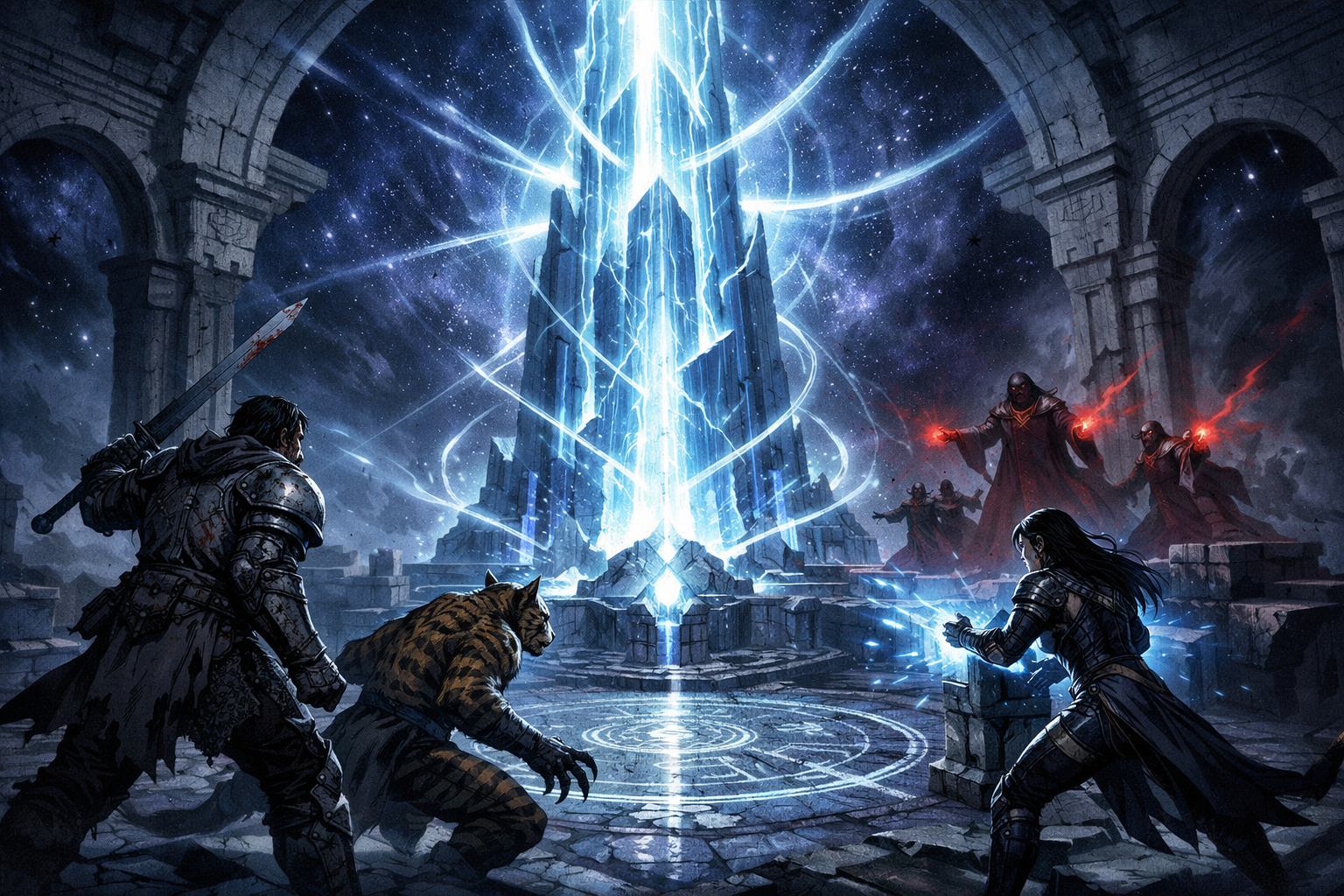
The heart chamber is vast, round, and wrong in scale. Its ceiling rises into darkness, and the walls curve as if the room was grown rather than built. In the center stands the Aetherius Pylon, a towering crystal and mechanism fused together, part mineral and part engineered lattice, threaded with channels that carry pale cosmic light like veins. It does not glow like a torch. It glows like a star seen through ice. Thin rays spill from it at irregular angles, touching wall inscriptions that flare in response, as if the entire chamber is a circuit.

Around the pylon, a ring of plinths waits, each etched with scripts that do not fully match Dwemer markings, older and stranger, like a Merethic mage tried to write mathematics with prayer. The air is cold and clean. Each breath feels borrowed. And beneath everything is a sensation that makes hair rise on the skin. The pylon is already connected to the sky. It has been waiting.

How to Run It

This scenario works best if activation is a sequence completed under pressure while the confrontation escalates. Do not reduce it to a single roll. Make it a ritual of actions with visible progress, each step achievable by different archetypes so every character can matter. While they do this, the enemy tries to break the sequence, corrupt it, steal the key, or simply kill the people doing the work.

Use mind pressure as a secondary threat. The room is an interface with the breaches of Aetherius. Looking at it too long should invite dread. Ask for discipline when someone stares into the pylon’s inner light, or when a ray strikes close and reality wobbles. Success is clarity. Failure is a short destabilization, vertigo that makes casting, aiming, and steady movement harder until the character regains control.

Play Sequence

Beat 1: The Threshold Break

The party enters the heart chamber and feels the room register them. Light shifts slightly. A ray touches a plinth and it flares, then fades, as if testing. The pylon’s hum deepens. There is a moment of silence where everyone understands this place is not empty, even before the enemy arrives. If you want to seed tension, let them hear a distant rhythm through the stone, not footsteps but something measured and patient, like someone who has never doubted their right to be here.

Beat 2: The Enemy Reveals the Price

The enemy arrives cleanly, because he believes cleanliness is proof of superiority. Vaelion Sul does not hurry into the chamber like a raider. He steps in as if he has always owned the room, as if the pylon has been waiting for the correct hand to touch it. His guard follows in close, the kind of disciplined closeness that turns three people into one threat with four hands free.

If you want a death that feels like consequence instead of random cruelty, tie it to the thing the party already fears. A second portal trembles at the edge of sight, a late reinforcement, a hand reaching through thin air to sabotage the sequence. Silene moves to cut it off because that is what she is. If the party supports her, pins the enemy long enough, grounds the shimmer before it becomes a door, she lives and returns with frost on her lashes and a look that says she will not speak about what she saw. If they do not, the portal takes her like a debt being collected. The pylon room still happens. It simply happens with fewer knives guarding the edges.

However you frame it, make the message immediate. The party has not been left undisturbed. They were followed, predicted, or simply anticipated. The enemy does not need a speech. The enemy needs the party to feel late.

Beat 3: Understanding the Pylon

The party must realize how to use the device while under threat. The plinths are not labeled in a friendly language. The clues are patterns and resonance. The aetherium fragment hums when brought near one plinth, then quiets when brought near another, as if telling them which key fits which lock.

This is where attention and craft become power. Let one character notice that rays form a repeating sequence across wall inscriptions. Let another recognize the sequence as lunar phase symbols. Let a third feel the fragment vibrate in rhythm with a specific console, as if the pylon recognizes the same material. Give them the core idea in a way that feels earned. Activation requires three alignments, a physical alignment of mechanisms, a resonance alignment with aetherium, and a mental alignment, sustained focus that keeps the room from turning thoughts into static.

Beat 4: The Activation Steps

Now the scene becomes a race, not away from the enemy but toward completion, and the enemy tries to stop them. First, align the consoles. Heavy rings must be turned, lenses shifted, components reordered. In low gravity, moving mechanisms is easier and more dangerous. A misstep sends you drifting. A failure does not end the process, it adds a complication, a ring snaps back, a hand is cut, a character is thrown into a slow fall that must be corrected before a beam line or blade edge claims them.

Second, seat the aetherium key. The fragment must be placed into a cradle that reacts like a living lock. The enemy will try to steal it, shatter it, or corrupt it. This is where protection becomes legend, a shield between a fragile action and a lethal spell, a body planted where it matters, because time is the only resource the party cannot replace.

Third, hold the focus. Once the pylon begins to respond, the room pushes back on minds. The breaches are loud here. Someone must maintain the pattern long enough for the cycle to complete. This is proof, not punishment. Mortals keeping their identity while touching the edge of something divine.

Beat 5: Duel Amid Cosmic Rays

As the pylon spins up, the fight becomes more surreal. Rays intensify. When spells strike the lattice, light bends, not like a mirror but like reality deciding how to interpret violence. Destruction magic looks sharper, leaving pale scars in the air that linger a heartbeat. Conjuration becomes unstable, summons arriving half formed or arriving with details wrong. Illusion becomes dangerously effective because the room already wants to turn perception into a lie.

Vaelion Sul fights like a strategist. He does not waste power on the toughest person if the problem is the one holding focus. He aims at concentration. He aims at the fragment. He aims at the mechanisms. His guard makes that strategy possible, turning every interruption into a coordinated cut while the pylon continues to charge.

Keep the room active. In low gravity, a shove can be worse than a cut. A missed jump can become a slow drift into a beam line. Give opportunities to use the environment, ropes, anchors, a broken lens to change a ray path, a sealed door to isolate the enemy for a few rounds.

Beat 6: The Final Interrupt

Right before completion, the enemy makes a last attempt, not subtle, desperate, the moment composure cracks. The Archmage tries to overwrite the activation, chanting in a language that bites the ear, risking feedback. His close guard moves to the cradle with practiced precision, blades and wards aimed at the hands that must not be allowed to finish, trying to rip the fragment free or knock the ring out of alignment in the last seconds.

This is where the party decides what kind of heroes they are. Hold the line and trust the activation. Abandon the ritual to kill the threat. Or gamble, a risky spell, a sacrifice of equipment, a dangerous leap, to buy the last seconds needed.

Make one thing explicit in play. Vaelion Sul and his close guard must die here. There is no clean retreat, no second attempt, no disappearing into politics. The pylon room is a hinge, and hinges do not tolerate unfinished threats. If the party wants the activation, they must remove the hands trying to take it. They can still choose how they do that, but not whether it happens.

If you want the rare fan moment and your table will love it, this is the only place it belongs. A tremor runs through the chamber as if the moon itself shuddered. Outside, unseen, the Sun Bird moves to answer its master, sliding into position like a blade coming to a hand. Its purpose is not spectacle. It is support: to add pressure, to add wards, to add a second angle of attack, to make Vaelion’s last interrupt inevitable.

It does not arrive cleanly. Akulakhan meets it in the breach-lit dark, and the collision is felt as a slow, heavy wave through stone. The pylon’s rays stutter for a heartbeat, reacting to violence on a scale that makes the air taste like brass. You do not need to show the whole battle. You only need the meaning. The Nerevarine is holding the Sun Bird off long enough for mortals to finish what only mortals can finish. Something impossible is buying minutes, and minutes are the rarest currency in the campaign.

Beat 7: Activation

When the pylon completes its cycle, it does not explode. It clicks into meaning. Rays lock into stable geometry. The hum becomes a clear, steady note. In that instant, the party feels a shift like pressure easing in the skull, as if the world itself unclenched.

Describe the effect as a ripple, not a beam. Far below, Numidium’s presence falters, not destroyed but denied. The titan’s reality bending does not vanish, but it loses its clean certainty, like a knife that cannot find the artery it expected. The Dominion’s working stutters as if rhythm was cut. The enemy in the room reacts with anger, disbelief, fear, because they understand what it means. The party did not win a fight. They changed the rules.
Outcomes

If the party activates the pylon successfully, they earn a window. Numidium is disrupted, diminished, forced into a less stable state, and the Dominion loses the ability to treat reality as a simple tool. This does not end the war. It changes the war back into something mortals can influence. The cost should be real, damage to the ship, exhaustion, a cracked fragment, a destroyed console, a character marked by Void dread in a way that will matter later.

If they fail to activate it cleanly, do not end the campaign. Let them activate it imperfectly, a partial shutdown, a shorter window, a dangerous side effect, a recharge cycle, or the activation imprinting itself on one person, making them a living key and a living target.

Ending

End on the moment after activation, not on celebration. The pylon’s light steadies, and the chamber becomes quieter in a way that is almost frightening. Dust hangs in low gravity like frozen smoke. Vaelion Sul and his guard are dead on the stone, because there is no other end to this room that leads cleanly into the next. The pylon does not forgive unfinished enemies. It only remembers outcomes.

Then give the cliffhanger that belongs to this act. The pylon does not feel like a button pressed once. It feels like a system now awake. A new inscription flares on the wall, one revealed only after activation. It is not a blessing. It is a direction, a coordinate, a name of a second site, or a warning that the lattice can hold only if something else is done.

The party stands on the moon with a tool that can wound a god machine, and they understand the next truth. Saving the world is never one switch. It is a chain of doors, and each door locks behind you as you pass.

Cliffhanger: the rings answer again, as if the moon has decided to keep listening.